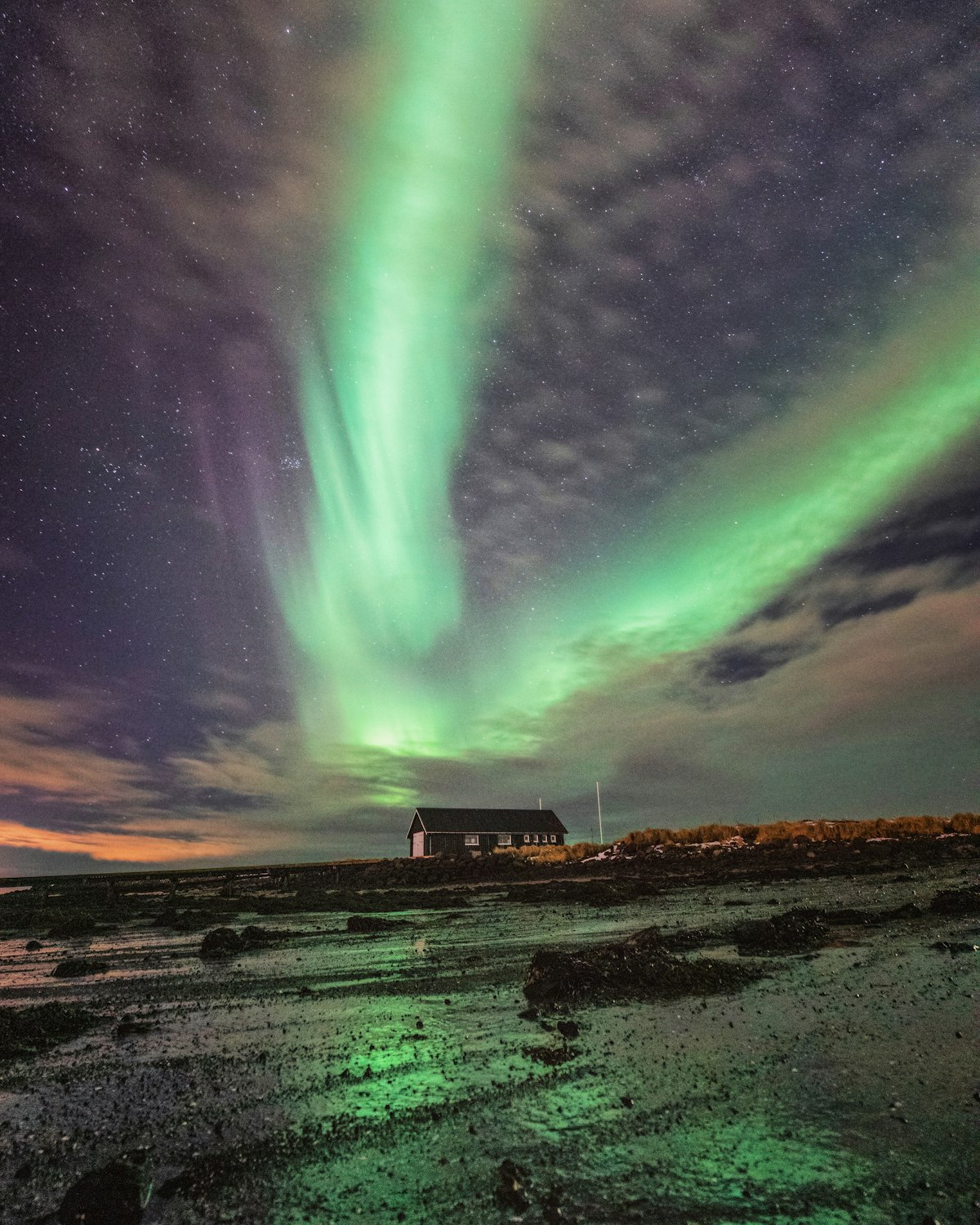
Ask anyone in Reykjavík where to go when the aurora is out and you will get the same answer: Grótta. It is the spot locals send first-timers to, the one every hotel front desk names, and the only genuinely good aurora location inside the capital that you can reach without a car. It is also the spot where visitors most often get the details wrong — the tide, the direction they face, and how much the city glow behind them actually costs.
This is the practical version: how to get to Grótta Lighthouse, where to stand once you are there, and the point at which you should stop trying to make Reykjavík work and drive 30 minutes east instead.
Where Grótta Is and Why It Works
Grótta sits at the far western tip of the Seltjarnarnes peninsula, about 5 km from downtown Reykjavík. The lighthouse itself stands on a small tidal island at the very end, joined to the mainland by a low spit of sand and rock.
Two things make it the best in-city option:
- An open northern horizon. You are looking out over open sea toward Faxaflói bay, with nothing between you and the northern sky. Aurora usually appears first as a low arc along the northern horizon, so an unobstructed north is worth more than almost any other single factor.
- The city is behind you. Walk to the tip and central Reykjavík sits at your back to the east. The light dome does not sit in the part of the sky you are watching — which is the whole trick to city aurora viewing.
Getting There Without a Car
Grótta is one of the very few aurora locations in Iceland that works on foot or by bus.
- On foot: roughly an hour’s flat walk from downtown along the coastal path past the Sun Voyager sculpture and around the Seltjarnarnes shoreline. Pleasant in September, brutal in a January gale.
- By bus: Strætó route 11 runs from the centre out onto Seltjarnarnes. Get off at Lindarbraut and walk about 10 minutes west. Check the last departure before you go — evening service thins out, and the aurora does not care about the timetable.
- By taxi: 10 minutes and typically around 2,500–3,500 ISK from the centre. On a night that is genuinely scoring well, this is money well spent, and it is the option we recommend in our guide to seeing the northern lights in Reykjavík without a car.
- By car: drive to the end of Norðurströnd, where there is a car park by the shore. Turn your headlights off as soon as you park — a set of running lights ruins night vision for everyone standing there.
The Tide Trap: Do Not Walk Out to the Lighthouse
This is the one thing to get right. The causeway to the lighthouse island is only exposed around low tide, typically for a window of a few hours, and it floods fast. People are cut off out there most years, in the dark, in winter, and it is entirely avoidable.
You do not need to cross to see the aurora. The view from the mainland shore is identical — the lighthouse is a foreground object, not a viewpoint. Unless you have checked a tide table and know exactly how long your window is, stay on the mainland side.
One other note: the island and shoreline are a protected nature reserve and closed for the Arctic tern nesting season, from 1 May until around mid-July. That falls entirely outside aurora season, so it rarely affects aurora hunters, but it is worth knowing if you are visiting in summer.
Where to Stand, and Which Way to Face
Once you are at the end of Norðurströnd, walk past the car park toward the shore and keep going until the last of the streetlights is behind you. Then:
- Face north to north-west — out over the water. That is where the arc forms.
- Put your back to the city. Even a few hundred metres of separation from the nearest lamp makes a visible difference.
- Give your eyes 20 minutes. Faint aurora reads as pale grey to the naked eye until it strengthens, and every glance at a phone screen resets your dark adaptation. If you are not sure what you are looking for, read what the northern lights actually look like to the naked eye before you go — it is the single best defence against disappointment.
- Dress for standing still. Grótta is a flat, exposed spit with the North Atlantic on three sides. It is meaningfully colder and windier than the sheltered streets you just left.
The Kvika footbath — a small geothermal foot pool set into the rock near the shore — is a nice touch on a mild night, though it can freeze over in deep winter.
The Honest Limitation
Grótta is the best spot in Reykjavík. It is not a dark spot. Our own data rates its light pollution as high, the same category as the rest of the capital — compare that with low at Heiðmörk, 20 minutes south-east, or at Þingvellir, 45 minutes east.
In practice that means Grótta needs a somewhat stronger display to deliver the same experience. A faint arc that would be obvious from Þingvellir can be washed out from Seltjarnarnes. If you have a car and the night is genuinely good, driving out is always the better call. If you do not, Grótta is a real option rather than a consolation prize — it produces good displays every season.
The other variable is cloud, which is the actual reason most people see nothing. Grótta gives you no ability to escape it: you are locked to one point on the map. If the coast is socked in and you have wheels, our guide to chasing a clear sky in real time explains how to reposition instead of waiting it out.
Make the Call Before You Leave
Grótta rewards a decision, not a hope. Check the live score for the spot first, aim for the 22:00–01:00 window when geomagnetic activity over Iceland tends to peak — the reasoning is in our guide to the best time of night — and then commit.
The Aurora Iceland app scores Grótta individually every five minutes, combining aurora probability, live solar wind and real cloud observations from Icelandic weather stations, so you can see whether tonight is worth the walk before you put your boots on. Open the Tonight page to check the current score, and if it says Possible or better under a clear sky, go — the tip of Seltjarnarnes is 10 minutes away.