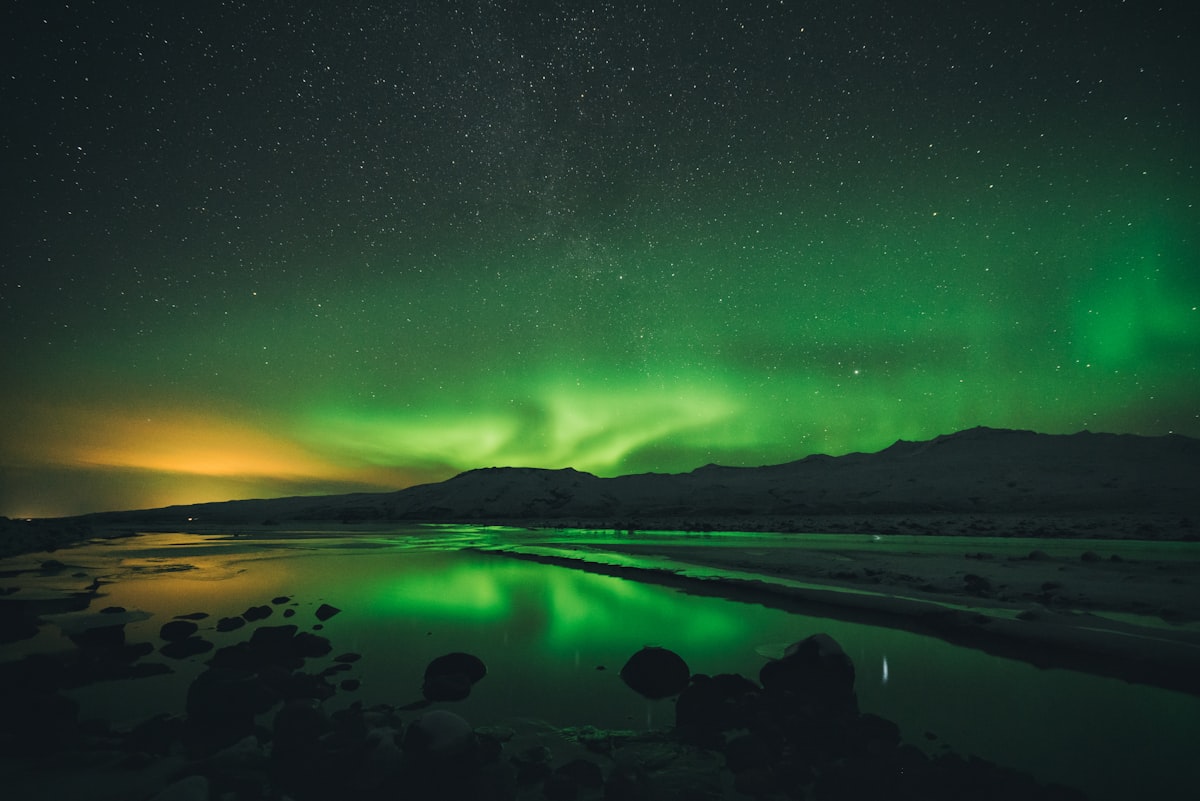
If you search “best aurora app for Iceland” you’ll find a small handful of names that come up again and again: Hello Aurora, AuroraVision, My Aurora Forecast, AuroraMe, PhotoWeather, Northern Lights Tracker, and now ours — Aurora Iceland. Most of the existing roundups are written from the outside, by travel sites and review aggregators that test the apps for an evening or two and rank them on screenshots. We build one of these apps from inside Iceland, watch the others closely, and use them ourselves on cloudy nights when our own forecast says we should drive somewhere else.
This is an honest comparison. Where the others do something well, we say so. Where we genuinely win, we explain why. And because the question that actually matters at 22:00 is not “which app has the nicest charts” but “which one will wake my phone up when there is something to see”, we start with the alerts.
What Aurora Forecasting Apps Actually Need to Do
A useful aurora app has to combine four independent signals into one decision:
- Geomagnetic activity — Kp index and the Bz component of the interplanetary magnetic field. Tells you whether the aurora is happening at all.
- Cloud cover — the single most common reason people miss the lights even when the sky is “active.”
- Darkness and twilight — sunset, astronomical dark, moon phase.
- Where you actually are — a Kp 4 over Reykjavík with a low overcast and a Kp 4 in the open sky 25 minutes east are completely different propositions.
The apps below all hit some of these. None of them hit all of them equally well. If you want the longer explanation of how the underlying numbers work, our forecast guide walks through the Kp index, OVATION, and cloud cover from the ground up.
Alerts Compared: The Three Ways an Alert Wastes Your Night
Almost every app on this page sends push alerts. The interesting question is what makes one fire — because an alert is a promise that it is worth putting your boots on, and most of them are quietly promising something narrower than you think.
A geomagnetic alert tells you the sky is active. It does not tell you the aurora is visible from where you are standing. Those are different claims, and there are exactly three ways the gap between them costs you a night:
- Cloud overhead. The single most common one. A Kp 5 alert is worthless under a solid deck, and Iceland’s maritime weather produces a lot of solid decks. An alert that has not looked at the cloud above your location has not checked the thing most likely to ruin the night.
- Lingering twilight. In late August and early September the sky is geomagnetically active long before it is dark. Reykjavík’s first true astronomical night is 2 September — an activity-triggered alert on 25 August is telling you about an aurora you cannot see.
- Town glow. A faint arc that would be obvious from a dark spot is invisible from a lit car park twenty minutes away. Same sky, same Kp, different answer.
Here is how the alerting models differ:
- National Kp threshold (My Aurora Forecast, Northern Lights Tracker, AuroraMe) — fires when a global or national activity number crosses a level you set. Simple, works anywhere in the world, and blind to all three problems above.
- Sightings and live activity (Hello Aurora) — fires when other aurora hunters report seeing the lights or when a geomagnetic substorm begins, and its Pro tier adds custom Bz thresholds and filters for distance, intensity and photo-only reports. A sighting is genuinely strong evidence, and we would rather have it than not: a real sighting beats any model. The honest limitation is that even a nearby sighting is evidence about the sky where they are standing, and Icelandic cloud can change from one valley to the next, so “someone saw it” and “you can see it” are not quite the same sentence.
- Per-location visibility score (AuroraVision, and us) — fires when a combined score for your own position crosses a threshold. This is the right model, and AuroraVision deserves credit for shipping it; it is the closest competitor on this page.
What we do differently, and why it means fewer alerts
Our alerts gate on the same per-spot score the app shows you, and they are deliberately conservative. Concretely:
- Nothing fires in daylight. Alerts are suppressed unless the sun is genuinely down over Iceland, which is what kills the twilight false alarm in the shoulder season.
- “Good” or better before we call a night special. The forecast alert, which tells you tonight looks unusually good, only fires when a spot reaches the Good tier or above on our 0-100 scale and the solar wind is favourable, not on any uptick.
- A favourable solar wind alone is never enough. We watch Bz turning south, which is the real switch-on signal for a live display — but that alert also requires the sky above you to be dark, the cloud to be light enough to see through, and your location to score at least 30 on the same scale. If Bz goes beautifully negative over an overcast Reykjavík, your phone stays quiet. That is on purpose.
- Limits on repeats. At most one forecast alert and one sighting alert a night, at least three hours between solar-wind alerts, and a separate opt-in for each alert type.
The result is that we send fewer notifications than a Kp-threshold app, and that is the feature rather than a limitation. An alert you have learned to ignore is worse than no alert, because the one night it was right, you swiped it away. Our cloud figure is an observed vedur.is SYNOP station report wherever a fresh one is close enough to trust, with forecast models filling the gaps — the same reason our forecast disagrees with national numbers, explained in how accurate the aurora forecast really is.
The honest caveat: a conservative alert will occasionally miss a brief, faint display that a twitchier app would have caught. If you want to be told about everything, a Kp-threshold app set low will do that, and you should use one.
Hello Aurora
Hello Aurora is the most-recommended Iceland-built competitor, and it deserves the recognition. Its biggest strength is the community sightings feed — people drop pins with photos when they see the lights, and the map fills up over the course of a night with crowd-sourced ground truth. Around that sits live data: an aurora-strength reading from real-time magnetometer stations, cloud cover from MET Norway and OpenWeather, and a cloud map built on data from Germany’s DWD, with total and low-cloud layers. It’s a friendly, well-designed companion app, and it travels: its sighting alerts cover 13 countries, including Norway, Sweden, Finland, Canada and the US.
Its forecast is localized, too. Kp is a planetary index and reads the same wherever you are, but Hello Aurora’s aurora strength comes from the magnetometer readings closest to you, and its aurora chance combines live space weather with the weather and cloud cover at your location, refreshed every few minutes. The main difference from ours is what the forecast is built around: Hello Aurora works from your position (or a location you save), and its cloud map lets you look for breaks in the cloud elsewhere, while Aurora Iceland scores 137 named viewing spots and ranks them against each other. Both are reasonable designs that start from different questions: “what is the sky doing where I am?” versus “which of these spots is best right now?”
Correction, 14 September 2026: an earlier version of this article said Hello Aurora uses vedur.is cloud data, gives a national rather than a localized forecast, alerts only on community sightings and works only in Iceland. All four were wrong. This section, the alerts comparison above and the table below have been corrected. Thanks to the Hello Aurora team for pointing it out.
AuroraVision
AuroraVision (auroravision.is) is Icelandic, free on iOS and Android, and the closest functional competitor on this page — it is the only other app here built around the same core idea, that the number worth alerting on is a visibility score for your specific location rather than a national Kp. It combines live Kp, solar wind and cloud cover into a score it refreshes every two minutes, sends push alerts when that score crosses a threshold you set, and covers the wider aurora belt — Norway, Finland, Sweden, Tromsø, Lapland, Alaska and the Yukon — as well as Iceland.
We are not going to pretend the gap is bigger than it is. If you want a free per-location visibility score with threshold alerts, it does that. The differences that remain are in the plumbing rather than the concept: our score runs against a fixed grid of 137 named Icelandic spots across 14 regions, each tied to the observed cloud reading from its nearest vedur.is SYNOP station whenever a fresh one is in range rather than to a modeled cloud field alone, and when your spot clouds over we route you to the nearest one that is actually clear. Judge both on that axis and pick whichever answers your question better.
My Aurora Forecast
My Aurora Forecast (by jRustonApps) is the most-cited name in the 2026 roundups and probably the most widely installed aurora app in the world. It is genuinely good at what it is: a free, global Kp-and-charts app with an OVATION world map, solar wind statistics, sun imagery, and Kp forecast graphs running from the next hour out to the next two weeks. It sends free push notifications when auroral activity is expected to be high, and it will browse aurora tours for you.
Its limitation for an Icelandic trip is the one this whole article is about: it forecasts the aurora, not your night. There is no Iceland spot layer, no observed Icelandic cloud data, and the alerts are activity-threshold alerts, so all three failure modes in the section above apply. If you are aurora-curious across several countries and want the best free global picture, it is an excellent pick. If your question is which Icelandic valley is clear at 23:00 tonight, it is not built to answer it. The two-week Kp graph in particular deserves a warning — no aurora forecast is meaningful that far out, for reasons we cover in how accurate the aurora forecast really is.
Northern Lights Tracker
Northern Lights Tracker is a newer global entrant built on NOAA space-weather data, with magnetic-latitude calculations, interactive aurora maps, daily summaries and high-Kp warnings, and a recently added cloud-cover feature. It presents a handful of headline destinations — Tromsø, Rovaniemi, Reykjavík, Fairbanks, Yellowknife, Kiruna.
That list is the tell. Reykjavík is there as one city among six worldwide, which is a reasonable design for a global app and a poor fit for a country where the useful decision is between spots forty minutes apart. Its alerts are Kp-and-position based rather than visibility based. Worth knowing about; not the tool for an Icelandic road trip.
AuroraMe
AuroraMe is polished, with a clean push-notification system that pings you when activity rises above a threshold you set. It pulls from NOAA OVATION and gives a global view, which is its strength — it works the same in Tromsø, Fairbanks, or Iceland.
The trade-off is that the global focus comes at the cost of local resolution. There’s no Iceland-specific cloud-cover layer from vedur.is, no community sightings, and no per-location scoring. If you’re not sure whether to drive to Þingvellir or Garðskagi tonight, AuroraMe will tell you the Kp is 4 and leave the rest to you.
PhotoWeather
PhotoWeather is the closest stack-similar competitor we have. It pairs NOAA OVATION with modeled cloud cover and a clean photographer-focused interface — sun and moon altitude, golden hour, blue hour, the whole astronomy stack. For trip planning two or three days out, it’s genuinely good.
What it doesn’t do is real-time spot-level routing for Iceland. The cloud cover comes from a global model rather than the SYNOP weather stations vedur.is operates around the country, so when actual conditions diverge from the model — which happens often in Iceland, especially near the coasts — PhotoWeather is a step behind reality.
Aurora Hunt
Aurora Hunt (aurorahunt.app) is the newest entrant and the one whose pitch sits closest to ours: localized decision support — should I go out now, from where I am, under tonight’s clouds — rather than a single national number. If you like the idea of an app that answers a question instead of showing you a dial, it is worth a look.
The open question is depth of local data. Our moat is not the concept, it is the plumbing: a fixed grid of 137 named Icelandic spots across 14 regions, each scored against the observed cloud reading from its nearest vedur.is SYNOP station whenever a fresh one is in range rather than a cloud model alone, plus routing that tells you which of those spots is clear right now. Judge any competitor on that axis — does it know that this specific valley is clear tonight, or only that Iceland is partly cloudy?
Aurora Reykjavik
Aurora Reykjavik is the Reykjavík aurora centre’s “official live forecast” web page rather than a mobile app, and it is a good free reference: a national Kp reading, cloud maps, and clear beginner explanations, from a team that has been explaining the aurora to visitors for years.
Because it is a web page, it does not do the things a phone in a car does — no push alerts when activity spikes, no GPS-relative scoring, no routing from your current position. It is a solid pre-trip read that pairs naturally with an app for the actual night. If you are choosing where in Iceland to be in the first place, our month-by-month October guide covers that side.
Aurora Iceland — What We Built and Why
We built Aurora Iceland because we kept driving out at midnight, opening three apps, looking at vedur.is on a separate browser tab, and then making the call ourselves. The app is the call, automated.
It scores 137 individually mapped viewing spots across 14 regions every five minutes. Each score combines:
- NOAA OVATION aurora probability for that exact latitude/longitude
- Live solar wind (Bz, speed, density) from DSCOVR
- Real cloud cover from the nearest vedur.is SYNOP station — observed, not modeled, whenever a fresh report is in range (forecast models fill the gaps)
- Local darkness and moon phase
When the score for your current location drops because of cloud cover, the app’s route planner tells you the nearest spot that’s actually clear right now and how long it’ll take to drive there. The Tonight page shows the top-scoring spots ranked live. Community sightings layer in for ground-truth confirmation, like Hello Aurora’s feed but pinned to the same spot grid the forecast uses.
Where the others are stronger: AuroraMe is better outside Iceland. Hello Aurora’s photo community feed has more years and more participants. PhotoWeather’s photographer tooling (golden hour, full astronomy) is more complete than ours, because we deliberately scoped to aurora hunting rather than general astrophotography.
Quick Comparison
Rows are apps, so it stays readable on a phone.
| App | Iceland resolution | Cloud data | What triggers an alert | Community | Outside Iceland |
|---|---|---|---|---|---|
| Aurora Iceland | 137 spots / 14 regions | Observed (vedur.is SYNOP), model fallback | Favourable solar wind while your sky is dark and clear; aurora sightings nearby; an unusually good night | Yes | No |
| AuroraVision | Per-location score | Modeled | Per-location score vs your threshold | No | Yes |
| Hello Aurora | Localized | Observed (MET Norway, OpenWeather, DWD) | Community sightings nearby (by intensity, distance, with or without photos), substorms (by intensity), space-data thresholds | Yes (largest) | Yes |
| Aurora Hunt | Localized | Unclear | Localized conditions | No | No |
| My Aurora Forecast | Global only | None | Global/national Kp activity | No | Yes |
| Northern Lights Tracker | Reykjavík as 1 of 6 cities | Recently added | Kp threshold + position | No | Yes |
| AuroraMe | National | No | Kp threshold you set | No | Yes |
| PhotoWeather | National | Modeled | Kp threshold | No | Yes |
| Aurora Reykjavik | National | Cloud maps | No alerts (web page) | No | No |
How to Pick
Use Aurora Iceland if you’re driving in Iceland this season and your single biggest enemy is cloud cover — which it almost certainly will be. The spot-by-spot scoring, the conservative alerts, and the real-time clear-sky routing are what we built the app to do.
Use Hello Aurora alongside it for the deepest community photo feed and a friendly local interface — the two complement each other rather than overlap, and a real human sighting is worth having next to a model.
Use AuroraVision if you want a second per-location opinion, or if the same trip continues into Norway or Finland — it is the nearest thing to us on this list and it travels further.
Use My Aurora Forecast if you want the best free global picture and the widest set of Kp charts, and you are aurora-curious well beyond Iceland.
Use AuroraMe if your trip continues into Sweden, Finland, or Alaska — its global model and clean threshold alerts travel well.
Use PhotoWeather if you’re a photographer planning compositions days out — its astronomy tooling is more complete than anything aurora-specific.
The honest verdict: no single app is the right answer for every traveler, and several of these are good. But for Iceland, on a cloudy night, with a rental car, the question of which spot is clear right now is the one that decides whether you see the lights — and the corollary is that the alert worth having is the one that stays silent when the answer is “nowhere near you”. That’s what the Aurora Iceland app was built to answer. When it does wake your phone, our playbook for a cloudy night covers what to do next; the Tonight page shows the top-scoring spots ranked live in the meantime.
One tool on this page is not an app at all and is worth knowing about: a live camera reports what the sky is actually doing rather than what a model predicts. See our guide to reading an Iceland aurora webcam for what one can and cannot tell you.