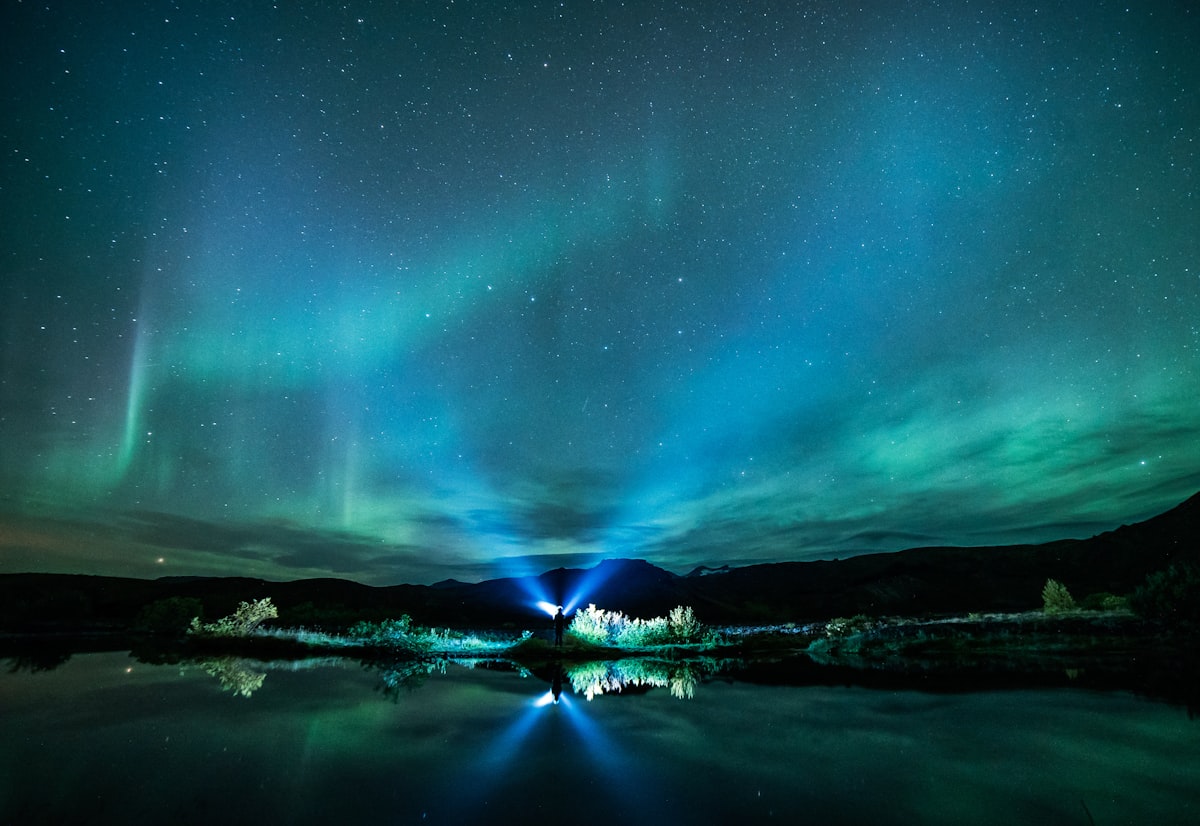
If September is the month the aurora calendar reopens in Iceland, October is the month it hits full stride. September has the equinox, but its dark window starts the month barely an hour long. By October the nights are long, genuinely dark, and start early enough that you don’t have to stay up until 1 a.m. to begin watching — and the storm odds are still close to their equinox peak. For most travelers, that makes October one of the easiest months of the season to actually see the northern lights.
Here’s an honest look at what October 2026 offers — the darkness, the moon, the weather and the storm odds — and how to plan around them. The forecast part is updated as it firms up, so it comes first.
Update, 23 September: What the Forecast Says So Far
Nobody can forecast a specific October night from two weeks out, but four things are already on the table — and two of them are a useful lesson in how much a forecast is worth.
NOAA’s 27-day outlook, issued 21 September, now reaches 17 October, and its most active run is still Kp 4 on 5 and 6 October. That is 27 days after the storm of 7-8 September, when Kp held at 4 or above across Iceland’s dark hours — the same stretch of the Sun coming back round, which is how the outlook is built. Both nights are moon-free until a thin crescent rises, at 00:49 on the first and 02:47 on the second. Two weeks out, that is a hint rather than a forecast; why the same aurora storm comes back 27 days later explains what it is worth.
Mid-September is the cautionary half of that story. NOAA issued a G1 storm watch on 14 September for the 15th and 16th, replaced it on the 15th with one for the 16th and 17th, and warned overnight that Kp 5 was expected. None of it arrived. The planetary Kp topped out at 3.67 on the 16th and 3.00 on the 17th, and the highest threshold actually crossed all week was Kp 4, twice. The 27-day outlook had been raised to Kp 5 for those same two days, at two and three days’ notice, and the planetary A index came in at roughly half what it forecast. A watch is a prediction, not a report — and it is the same outlook, from the same forecasters, that puts Kp 4 on 5 and 6 October. Treat those dates as worth watching, not as a booking.
And yet people saw the aurora anyway. Sightings came into our community feed on the nights of 14, 15 and 17 September — from Borgarfjörður in the west, from above Akureyri in the north, and from the southeast — on nights when the planetary Kp sat between about 2.3 and 3.3. The brightest of them, a broad green band with clear structure in it, was photographed at Kp 2.67; a higher-Kp night the following evening produced only a faint smudge. In Iceland you are already under the auroral oval, so the Kp number tells you much less than darkness and cloud do.
The coronal hole question now has an answer, and it is a modest one. The coronal hole behind that mid-September activity would be due back around 12-13 October, in the middle of October’s moon-free run, if it survives a full rotation of the Sun. The 21 September issue is the first outlook that reaches that far, and it lists Kp 3 for 11 to 14 October: one step above the quiet Kp 2 on either side, with a planetary A index of 8 or 9. So NOAA expects something to come back, weakly, and nothing like the Kp 5 it gave the same stretch of the Sun in mid-September. That is not a reason to avoid those nights. They are moon-free, and a Kp 3 night was producing visible aurora in mid-September. It is a reason not to build a trip around them.
October’s Real Advantage: Long, Truly Dark Nights
In the first week of September, true astronomical darkness in Reykjavík barely exists — it starts near midnight and lasts an hour or two. October is a different sky. By October 1, the sun sets at 18:59, the sky is usably dark from 20:41 and fully astronomically dark from 21:41; by October 31, sunset is 17:16, usable dark starts at 19:04 and full darkness at 19:59. (Iceland stays on UTC year-round, so there’s no clock change to track.)
That shift adds up to roughly 12 hours of usable darkness by the end of October — over 10 of them at full astronomical darkness — climbing toward the deep-winter maximum. The practical effect is enormous: you get a wide viewing window that includes convenient evening hours, you can catch the lights and still get a normal night’s sleep, and the long dark window means more chances to be watching during a sudden burst of activity. The aurora is bursty and unpredictable; the more hours of darkness you’re awake for, the better your odds. For why the 22:00–01:00 window still tends to be the sweet spot within that long night, see our guide to the best time of night to see the northern lights.
The geography of darkness evens out, too. In September the south coast is noticeably darker than the north, because darkness reaches it first. By 1 October the gap is small — Vík gets 7.4 hours of astronomical night to Akureyri’s 6.9 — and by the 31st the whole country is level at about 10.4 hours. From mid-November the north pulls ahead.
The Moon: Ten Moon-Free Nights in the Middle of the Month
The one part of October 2026 that is already certain is the moon, and it matters as much as anything else on this page. What spoils a faint aurora is not a bright moon but a moon that is above the horizon, lifting the background a display has to stand out against — our moon guide has the full explanation. New moon is 10 October and full moon is 26 October. Here is what that does to each night in Reykjavík, computed the way we model it internally:
| Nights | Astronomical dark | Moon-free dark |
|---|---|---|
| Oct 1-3 | 7.2 - 7.5 h | 0 h |
| Oct 4-7 | 7.6 - 8.0 h | 1.6 - 7.6 h |
| Oct 8-17 | 8.1 - 9.1 h | all of it |
| Oct 18-22 | 9.2 - 9.6 h | 8.6 down to 1.6 h |
| Oct 23-31 | 9.7 - 10.4 h | 0 h (0.7 h on the 31st) |
8 to 17 October is the stretch to aim for. Ten nights in a row get 8 to 9 hours of astronomical darkness with the moon below the horizon for every minute — more moon-free darkness than any stretch of the season so far. Either side of it the moon eats into the night: from the 23rd it is up for the whole dark window, and on 1-3 and 28-30 October it doesn’t set at all. A bright display will still show through moonlight. The faint ones won’t.
You may see 5-12 October quoted elsewhere as the best week of the month “because of Earth-Sun geometry”. The geometry is real, but it is the equinox effect, and as the storm-odds section below shows, it barely changes from the start of October to the end. What actually singles out the middle of the month is the moon: the new moon falls on the 10th. That is why the best window is 8-17 October rather than 5-12, and why 5 to 7 October, when the moon still rises part-way through the night, fall just short of it.
The Weather: Colder, Not Cloudier
Here’s the honest catch, and it isn’t the one you’ll usually read. October is not a cloudier month than September. Over 1991-2020 the Icelandic Met Office recorded an average of 5.7 eighths of cloud over Reykjavík in October against 6.0 in September, with slightly less rain; in Akureyri October comes out a little cloudier (6.3 against 6.1) and noticeably wetter. Average wind speeds barely move until November. What does change is the temperature: Reykjavík’s October average is 4.9°C against 8.5°C in September, and Akureyri’s is 3.5°C.
Cloud is still the number-one reason people miss the lights in Iceland, in October as in every other month. But “cloudy on average” is not the same as “you won’t see anything.” Weather systems move. They bring frontal gaps and clear slots, and Iceland’s weather varies dramatically over short distances — the south coast can be socked in while the north is wide open. The single biggest determinant of whether you see the aurora in October is not the geomagnetic forecast; it’s whether you’re willing and able to drive 30–60 minutes to find the clear patch.
This is exactly the gap our app is built to close. The live aurora forecast scores all 137 monitored spots every five minutes using real-time vedur.is cloud observations alongside the aurora model, so instead of guessing, you can see which specific location is both clear and active right now. For the days before you go, the Icelandic Met Office’s cloud map runs six days ahead, but its colours work the opposite way to what most visitors expect: how to read the vedur.is aurora map explains it. If you’re traveling in October, plan to move — a single fixed hotel will cost you nights you could have saved. For the full strategy on out-driving the clouds, read how to chase a clear sky in real time.
Storm Odds, and What Is Left of Solar Maximum
The autumn equinox (00:05 on September 23 in Iceland, which most travel sites date to the 22nd because that is what it reads as in US time zones) is the centre of the Russell-McPherron effect, the geometric reason geomagnetic storms are about twice as common around the equinoxes as around the solstices. It doesn’t switch off on October 1, and it doesn’t fade through the month either. In the planetary Kp record back to 1932, storm-level periods — NOAA G1 or stronger — make up 9.6% of three-hour periods in the first ten days of October, 8.5% in the middle ten and 9.2% in the last eleven, all close to September’s 9.5%. The drop comes in November: 7.5% in its first ten days, and under 6% after that. All of October is equinox season.
Solar Cycle 25 peaked in October 2024 and has been declining since; August 2026’s sunspot number was 76, about half of September 2024’s 141. Geomagnetic activity, which is what actually drives the aurora, has held up better: January to August 2026 averaged a planetary ap index of 12.6, above the same months of 2024. But that is close to the long-term average of 13.3 since 1932, not above it, and Octobers usually run a little livelier than that — 14.8 on average, with the last two at 19.0 and 15.6. So expect a normal October rather than a record one: good storm odds for the time of year, but nothing about the cycle that promises more than usual. The deeper science is in our piece on Solar Cycle 25 and the 2026 aurora season, and if you’re weighing September against October, our September 2026 guide covers the equinox month head-on.
Where to Go — and What’s Still Open
October is still a good month for access. The Ring Road is open, though the higher passes can see their first snow and ice, and from October Vegagerðin only updates road conditions between about 07:00 and 22:00 — what that means for night driving — so check road.is before any long drive. The highland F-roads are another matter: they close for the winter as the first snow reaches the interior, and by October most are shut, so don’t plan any route across the middle of the country. All three spots below are a drive rather than a bus ride after dark, so you’ll want your own vehicle; a base around the Golden Circle puts Þingvellir and plenty of other dark spots within reach. Three spots that are especially strong in October:
- Þingvellir National Park — 45 minutes from Reykjavík, dark, dramatic, and easy to reach on a Golden Circle loop. On a calm night the lake gives clean reflections.
- Jökulsárlón glacier lagoon — floating icebergs make unrivaled foregrounds, and the southeast can be clear when the southwest is clouded over. It is a five-hour drive from Reykjavík, so stay nearby rather than driving out for the night.
- Vestrahorn / Stokksnes — almost no light pollution and a jagged skyline. Stokksnes is private land with an entrance fee paid at the Viking Café, about six hours from Reykjavík, so treat it as part of a southeast base near Höfn; our Vestrahorn guide covers access and the tides.
One practical note: October nights are colder than September’s, and aurora hunting means standing still in exposed coastal wind for an hour or more. Dress for it — our winter packing list for aurora hunting covers exactly what that requires.
Some links in this guide are affiliate links: we earn a commission if you book, at no extra cost to you. It never affects what we recommend or how we score a spot.
How to Plan an October 2026 Trip
Three concrete steps:
- Aim for 8-17 October if you can. Ten nights of 8 to 9 hours of astronomical darkness with the moon down for all of them, at storm odds close to the equinox peak. If your dates are later, the storm odds hold up to the end of the month; it’s the moon, from the 23rd, that makes faint displays harder to see.
- Plan to move. Book a base with easy road access in multiple directions rather than committing to one fixed, scenic-but-remote spot. Your ability to drive to clear sky is the whole game in October. For how trip length changes your odds, see how many nights you need in Iceland.
- Install the Aurora Iceland app and turn on notifications before you arrive. We score 137 locations every five minutes on real-time solar wind, OVATION output, and live vedur.is cloud data, and the app alerts you when the solar wind turns favourable while the sky where you are is dark and mostly clear, or when aurora sightings are reported near you. If you want to see how that stacks up against the other tools, we compare them honestly in the best aurora apps for Iceland in 2026.
For the underlying mechanics — Kp, Bz, OVATION, and what to actually trust — see how to read an aurora forecast. And if your dates push later into the winter, our guide to the northern lights in Iceland in November 2026 covers the month after this one, when the nights get longer again. October 2026 gives you the longest dark nights of the season so far, storm odds still close to their autumn peak, and ten moon-free nights in the middle of the month. Bring a warm coat, stay mobile, and watch the sky — or better, let the app watch it for you and tell you when to look up.