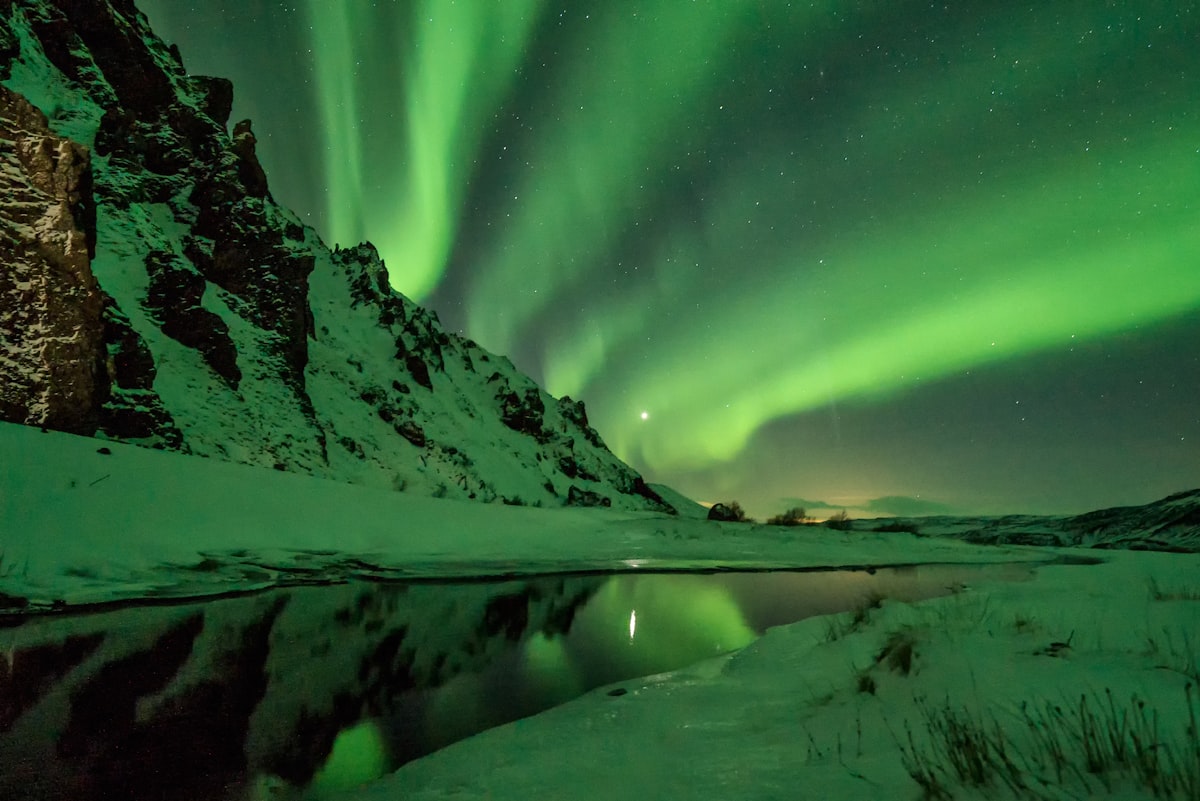
If October is when Iceland’s aurora season hits full stride, November is when darkness stops being a limiting factor at all. By now the long summer is a distant memory: the sun barely clears the horizon, and the night is so long you don’t have to plan around it. For the first time in the season, the question isn’t “will it be dark enough?” — it always is. The question is “will the sky be clear?”
That single shift defines November. Here’s an honest look at what the month offers in 2026, and how to plan around its real strength and its real weakness.
Deep Darkness Has Fully Arrived
In October you still got convenient early-evening darkness with a sensible bedtime. November takes it much further. By November 1, the sun sets at 17:13 in Reykjavík, the sky is usably dark from 19:01 and fully astronomically dark from 19:57. By November 30, sunset is 15:53 and sunrise isn’t until 10:38 — barely five hours of daylight — with full darkness running 19:03 to 07:31. (Iceland stays on UTC year-round, so there’s no clock change to track.)
That leaves roughly 14 hours of usable darkness by late November, 12.5 of them fully astronomical, climbing toward the December solstice maximum. The practical effect is that the aurora can be visible almost any time after dinner. You no longer have to choose between a sighting and a night’s sleep, and the enormous dark window means you’ll be awake for far more of the sky’s unpredictable bursts. The aurora is bursty by nature — the more dark hours you’re outside watching, the better your odds. The 22:00–01:00 window is still the statistical sweet spot for the strongest displays; for why, see our guide to the best time of night to see the northern lights.
November’s Real Challenge: Cloud, Not Darkness
Here’s the honest catch. Darkness is no longer the constraint — cloud is. That isn’t because November is an especially cloudy month. Over 1991-2020 the Icelandic Met Office recorded an average of 5.7 eighths of cloud over Reykjavík in November, the same as October and slightly less than September, and in Akureyri the months differ by a fraction of an eighth: cloud cover in Iceland barely changes with the season. What November changes is everything around it. It is colder than October — 2.2°C on average in Reykjavík, against 4.9°C — and windier, and with a dark window this long, cloud is the only thing left between you and the sky.
But “cloudy on average” is not the same as “you won’t see anything.” Weather systems move, and they leave frontal gaps and clear slots in their wake. Iceland’s weather also varies enormously over short distances — the south coast can be socked in while the north or the interior sits under clear sky. In November, the single biggest determinant of whether you see the aurora isn’t the geomagnetic forecast at all; it’s whether you’re willing and able to drive to find the clear patch.
This is exactly the gap our app closes. The live aurora forecast scores all 137 monitored spots every five minutes using real-time vedur.is cloud observations alongside the aurora model, so instead of guessing you can see which specific location is both clear and active right now. If you’re traveling in November, plan to move — a single fixed hotel will cost you nights you could have saved. For the full strategy on out-driving the clouds, read how to chase a clear sky in real time.
Plan Around the Moon
With darkness no longer the bottleneck, one factor that earlier-season articles can afford to skip becomes worth planning for in November: the moon. A bright full moon won’t hide a strong aurora, but it will wash out the faint-to-moderate displays that make up most nights, and it kills the deep contrast that makes photographs sing.
In November 2026 the new moon falls on November 9, so the darkest skies of the month run roughly November 5–13. If you can pick your dates and you’re chasing faint displays or photography, that week is the one to target. Around the full moon (late November), aim for the brightest, most active nights and head to your darkest spot to claw back contrast.
Solar Cycle 25: Past the Peak, Still Capable of Storms
You’ll see a lot of “last chance” marketing aimed at late-2026 travelers. The honest version is less dramatic in both directions. Solar Cycle 25 peaked in October 2024, when the smoothed sunspot number reached 160.9, and it has been falling since, with no second peak. August 2026 averaged a sunspot number of 76 on the provisional count, and since March the monthly figures have mostly come in below NOAA’s current prediction, which puts the smoothed number near 90 this autumn.
Sunspots are not what you are looking at, though. The aurora answers to geomagnetic activity, and that has held up far better. The first eight months of 2026 averaged a planetary ap index of 12.6, above the same months of 2024 (11.1), the year the sunspots peaked, though below 2025 (15.2). Geomagnetic activity tends to stay high, and sometimes peaks, in the years after sunspot maximum, when long-lived coronal holes send recurring high-speed streams of solar wind past Earth: cycle 24’s sunspots peaked in 2014, and its most geomagnetically active year was 2015.
For November, that means a Sun still capable of storms rather than a promise of them. The month sits between the stormy equinox months and the quiet depths of winter: in the planetary Kp record, which GFZ Potsdam keeps back to 1932, storm-level periods — NOAA G1 or stronger — make up 6.4% of all three-hour periods in November, against 9.1% in October and 4.1% in December. And any single month can land a long way from its average. November 2024, the month after the sunspot peak, had just 3 storm-level three-hour periods; November 2025 had 24. The deeper science is in our piece on Solar Cycle 25 and the 2026 aurora season.
Where to Go — and Winter Access
November is the threshold of winter, so access changes. The Ring Road stays open and maintained, but the highland F-roads are closed, the first serious snow and ice are on the ground, and you’ll want a vehicle with winter tires and the confidence to drive on it — compare cars and campervans across 30+ Icelandic suppliers, and in November treat 4x4 and studded tyres as the specification rather than the upsell. Daylight for getting around is short, so plan your driving for the few bright hours and your viewing for the long dark ones. Short daylight also argues for a base outside the city: in November you do not want to spend your short daylight driving out and back.
Some links in this guide are affiliate links: we earn a commission if you book, at no extra cost to you. It never affects what we recommend or how we score a spot.
Three spots that are especially strong in November:
- Þingvellir National Park — 45 minutes east of Reykjavík, dark and dramatic, and reachable on well-maintained roads even in early winter.
- Jökulsárlón glacier lagoon — floating icebergs make unrivaled foregrounds, and the southeast frequently catches clear slots when the southwest is clouded over.
- Akureyri and North Iceland — the north sits at high magnetic latitude with less driving to escape light pollution, and it often stays clear when an Atlantic front parks over the south.
One non-negotiable: November nights are genuinely cold and windy, and aurora hunting means standing still in exposed wind for an hour or more. Dress for it — our winter packing list for aurora hunting covers exactly what that requires.
How to Plan a November 2026 Trip
Three concrete steps:
- Stop worrying about the dark window — it’s wide open all month. Put your planning energy into weather and mobility instead.
- Plan to move, and target the new-moon week (around November 5–13) if you can. Book a base with easy road access in multiple directions rather than committing to one remote spot. Your ability to drive to clear sky is the whole game in November. If you are still deciding how long to stay, see how many nights you need in Iceland.
- Install the Aurora Iceland app and turn on notifications before you arrive. We score 137 locations every five minutes on real-time solar wind, OVATION output, and live vedur.is cloud data, and the app alerts you when the solar wind turns favourable while the sky where you are is dark and mostly clear, or when aurora sightings are reported near you.
For the underlying mechanics — Kp, Bz, OVATION, and what to actually trust — see how to read an aurora forecast. If your dates are a little earlier, our companion guides to the northern lights in October 2026 and September 2026 cover the months when the season ramps up; if they fall later, December 2026 has the darkest skies of the year and the festive-week trade-offs that come with them. November 2026 hands you the longest nights of the season so far and a Sun that is past its peak but still capable of storms. Bring a warm coat, stay mobile, and watch the sky — or better, let the app watch it for you and tell you when to look up.