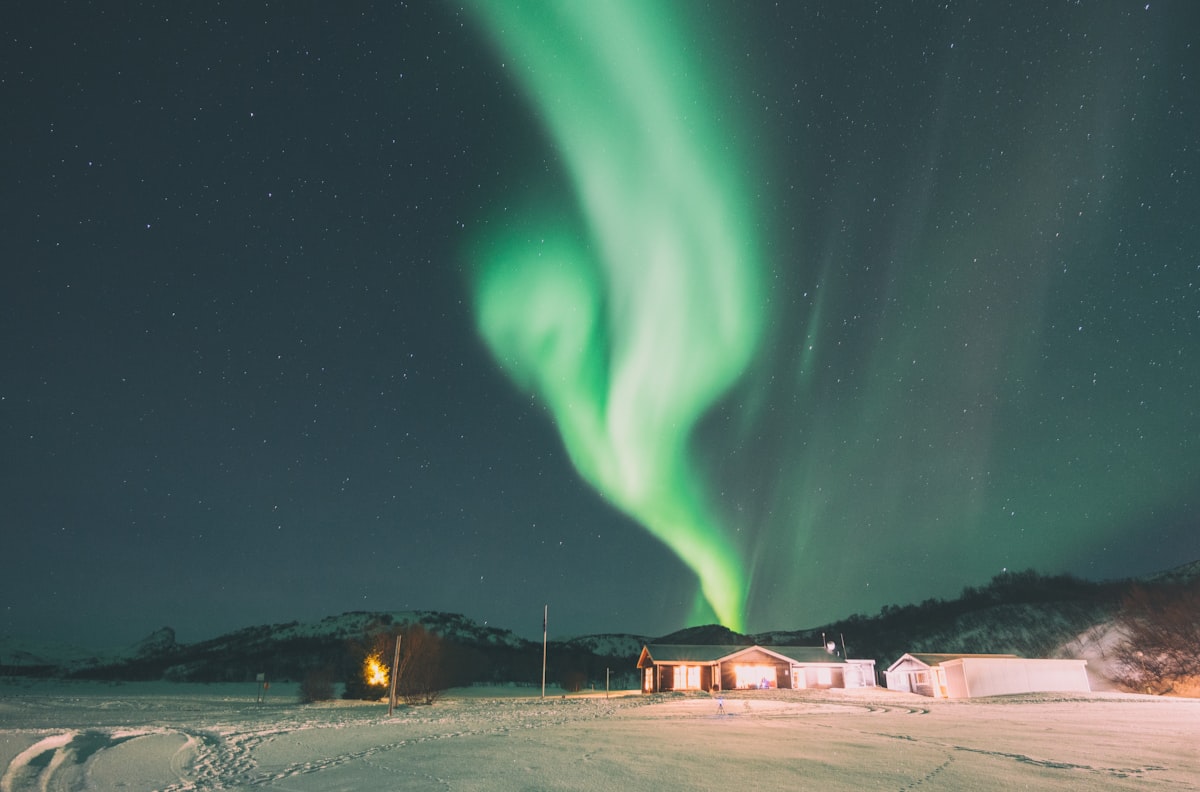
December is the month Iceland gives you the most darkness it has. Around the winter solstice the sun is above the horizon for barely four hours, which leaves close to twenty hours of night — more sky-watching time than any traveler can realistically use.
It is also, statistically, one of the hardest months to actually see the aurora. Both of those things are true at once, and understanding why is the whole difference between a great December trip and a frustrating one.
Almost Twenty Hours Without the Sun
The numbers are genuinely extreme. On December 1 the sun rises in Reykjavík at 10:41 and sets at 15:51 — roughly five hours of daylight. By the solstice on December 21 it’s down to 4 hours and 17 minutes, with sunrise at 11:17 and sunset at 15:34. By December 31 you’re at 4 hours 31 minutes and climbing again, barely. (Iceland stays on UTC year-round, so there’s no clock change to track.)
Worth separating two numbers that most December guides run together. The sun is below the horizon for nearly 20 hours at the solstice, but it takes a while after sunset for the sky to actually go dark: usable darkness runs 17:58 to 08:54, and full astronomical darkness 18:58 to 07:54 — just under 13 hours. That is still the longest dark window of the year by a wide margin.
The practical effect: the sky is properly dark by early evening and stays dark until nearly lunchtime. You can be watching for the aurora at 19:00 and still be watching at 03:00. Since the aurora is bursty and unpredictable, more dark hours outside means more chances to catch a substorm. The 22:00–01:00 window is still the statistical sweet spot for the strongest displays — see our guide to the best time of night to see the northern lights — but in December you genuinely have the option to keep looking either side of it.
December’s Real Problem Is Weather, Not Darkness
Here’s the honest catch. December sits in the heart of the North Atlantic storm track, and it is one of Iceland’s windiest and wettest months — on the Icelandic Met Office’s 1991-2020 averages, the wettest of the year in Reykjavík. It is not a cloudier month, though. Reykjavík averages 5.8 eighths of cloud in December against 6.0 in September, and in Akureyri the months differ by a fraction of an eighth: cloud is a year-round problem in Iceland, not a winter one. It is still, by a wide margin, the number-one reason travelers go home without seeing anything. The geomagnetic forecast can be excellent and completely irrelevant if there’s a solid deck of cloud between you and the sky.
December’s other handicap is above the cloud. It is the quietest month of the year geomagnetically: in the planetary Kp record, which GFZ Potsdam keeps back to 1932, storm-level periods — NOAA G1 or stronger — make up 4.1% of all three-hour periods in December, the lowest of any month, against 9.5% in September. The long nights give you more hours to catch what does happen. They do not make it happen more often.
The saving grace is that Iceland’s weather is intensely local. A front parked over the south coast often leaves the north or the east under clear sky, and gaps open behind every storm system. In December, the single biggest factor in whether you see the aurora isn’t the Kp number — it’s whether you can move to where the sky is clear.
That’s exactly the gap our live aurora forecast closes: 137 monitored spots scored every five minutes using real-time vedur.is cloud observations alongside the aurora model, so you can see which specific location is both clear and active right now rather than guessing from a national map. For the full strategy, read what to do when it’s cloudy.
Is December a Quiet Aurora Month?
For storms, yes. Guides give opposite answers to this question, and each is pointing at something true, so it helps to separate the two things they mean. Geomagnetic storms follow the calendar: they cluster around the equinoxes in March and September and thin out toward the solstices, which is why December has the lowest storm share of any month in the Kp record quoted above. If your picture of the aurora is a Kp 6 night with red above the green, December is the month least likely to hand you one.
But Iceland does not need a storm. The island sits under the auroral oval, the ring where the aurora appears on ordinary nights, so a display here takes far less activity than one over Scotland or Germany. This season our community feed has logged photographed aurora on nights when the planetary Kp read 2 or lower. What December gives you is not more activity but more time: almost 13 hours of full darkness every night, the most of any month. A quiet month with long nights still produces plenty of aurora. It produces fewer of the nights that make the news.
Target the New-Moon Week: December 5–13
With darkness effectively unlimited, the moon becomes a lever worth planning around. A full moon won’t hide a strong display, but it washes out the faint and moderate auroras that make up most nights, and it flattens the contrast that makes photographs work.
In December 2026 the new moon falls on December 9, so the darkest skies of the month run roughly December 5–13. If your dates are flexible and you care about faint displays or photography, that’s the week to book — what is available in the Þingvellir corridor that week is the single most useful thing you can lock in, because it is both dark and close enough to Keflavík to survive a December weather delay. Note that the full moon lands on December 24 — Christmas Eve and the days around it will be the brightest, most moonlit nights of the month. If those are your dates, head to your darkest spot and hope for an active night rather than a subtle one.
Update, 25 November: The Dates the Outlook Flags
NOAA’s 27-day outlook issued on 23 November runs to 19 December, and two dates in it stand out. Friday 4 December is at Kp 5, storm level (G1), with Kp 4 on the 5th and Kp 3 on the 6th. The date is not an accident. It is 27 days, one rotation of the sun, after the storm of 7 November, which reached Kp 5.33 between 18:00 and 21:00 UTC. The same coronal hole is turning back to face Earth, and storms from coronal holes tend to return on that 27-day beat.
The timing is as good as December gets. On 4 December the moon is a thin waning crescent that sets in the early afternoon and does not rise again until about 06:50 the next morning, so nearly the whole night is moon-free, and it leads straight into the new-moon week above. 16 December is the second date, at Kp 4, one rotation after the short storm in the early hours of 19 November. That evening is not moon-free: the moon is about half lit and up until around 01:00, so the darker hours come after that. The nights from 7 to 14 December all sit at Kp 2, which over Iceland still means aurora is possible wherever the sky is clear.
Treat these as a forecast, not a promise. This autumn the 27-day outlook has usually picked the right window and missed the hour or the strength: its Kp 5 line for 17 and 18 November arrived as a G1 storm in the first hours of the 19th. We will add here what 4 December delivers. For what each forecast range can and cannot tell you, see how accurate the aurora forecast is.
Is the Winter Solstice a Good Night for the Northern Lights?
It is the longest night, not the likeliest one. The 2026 solstice falls at 20:50 UTC on Monday 21 December, and that night Reykjavík has full astronomical darkness from 18:58 to 07:54. Nothing about the solstice itself makes the aurora more active. The aurora is driven by the solar wind, not by how long the night is, and the one seasonal effect that exists favours the equinoxes, not the solstices.
In 2026 the moon settles it. On the solstice night the moon is 93% lit and above the horizon for the entire dark window, with the full moon following on 24 December. A strong display will still show, and moonlit snow makes a fine foreground, but faint aurora will be washed out. If you are choosing dates for darkness, the nights around 9 December are far darker than the solstice. If the solstice is when you are here, our moon phase guide explains what a bright moon does and does not hide.
Why a Car Matters More Than the Calendar
With cloud this changeable and storms this bursty, the biggest difference between two December trips is not the dates but the ability to move. A traveler with a car who is willing to chase clear sky has a very different month from one without, because the car is what lets you get out from under cloud. If you need one, compare 4x4s and SUVs from Icelandic suppliers and take the 4x4 for December.
Some links in this guide are affiliate links: we earn a commission if you book, at no extra cost to you. It never affects what we recommend or how we score a spot.
The other lesson is the one every month of the season teaches: book more nights than you think you need. Each extra night is another chance for a clear sky and an active one to arrive together.
Winter Driving, Holiday Prices, and Where to Go
December is real winter, and that changes the logistics.
Roads. The Ring Road stays open and maintained, but the highland F-roads are closed, snow and ice are constant, and high winds close sections at short notice. You want a vehicle with proper winter tires and the confidence to use it. Check road.is before every drive, and plan your driving for the few daylight hours — navigating unfamiliar icy roads in the dark is a different task entirely.
Prices. Christmas and New Year are peak weeks for accommodation and car rental, and the last week of December books out early. The first half of the month is both cheaper and — conveniently — the new-moon window. Our Christmas and New Year guide covers those weeks night by night.
Three spots that hold up well in December:
- Þingvellir National Park — 45 minutes from Reykjavík on a maintained road, genuinely dark, and easy to reach on a short winter afternoon.
- Jökulsárlón glacier lagoon — icebergs make unbeatable foregrounds, and the southeast often catches clear slots when the southwest is socked in.
- Mývatn — high magnetic latitude, very little light pollution, and the north frequently stays clear while Atlantic fronts sit over the south.
Standing still outdoors for an hour in a December wind is colder than almost anyone expects. Our winter packing list covers what that actually requires.
Planning a December 2026 Trip
- Forget the dark window — it’s the least of your problems. Put your planning energy into weather flexibility and mobility.
- Aim for December 5–13 if you can choose. Darkest skies, and ahead of the holiday prices and crowds.
- Stay mobile and book a base with roads running in several directions, rather than committing to one remote valley.
- Install the Aurora Iceland app and turn notifications on before you land. We score 137 locations every five minutes on live solar wind, OVATION output and real cloud observations, and the app alerts you when the solar wind turns favourable while the sky where you are is dark and mostly clear, or when aurora sightings are reported near you.
If your dates fall a little earlier, our guide to the northern lights in November 2026 covers the month before this one, and how to read an aurora forecast explains the Kp, Bz and OVATION numbers underneath it all.
December hands you the longest nights Iceland will ever offer. Bring the warmest coat you own, keep your plans loose, and let the forecast tell you where the clear sky is — then go stand under it.