September is the month the aurora calendar starts working again in Iceland. August reopens the season, but it does it in twilight: true astronomical darkness — the sun a full 18° below the horizon — didn’t reach Reykjavík until 2 September this year, and didn’t reach Akureyri until the 6th. September is the month that changes, and it changes fast. By the second week the sky is properly dark, and it stays dark long enough for the lights to be visible on almost any active night.
Two more things decide what the rest of the month is worth: the autumn equinox, which makes geomagnetic storms about twice as common as they are around midsummer and midwinter, and the moon, which in September 2026 splits the equinox fortnight in two. This guide covers both, along with what is left of solar maximum, and it is updated as the month goes — so it starts with where things stand now.
Update, 15 September: The First Half, and What Is Left
The first fourteen nights brought one clear hit. On 7-8 September activity held at Kp 4 or above across the whole dark window, and our community feed logged seven sightings from five people, from the Westman Islands to the Strandir coast — six of them before the sky was even astronomically dark. The full account of that night is worth reading if you are here now. Otherwise the fortnight was quiet. GFZ Potsdam’s provisional Kp record has the planetary index reaching 3 during Reykjavík’s dark hours on five more nights (the 8th, 9th, 10th, 12th and 14th) and never 4, and the 12-14 September nights that NOAA’s 27-day outlook had flagged for weeks came in much as it said, at Kp 2 to 3. Our feed is still small, so a night without posts is not proof of an empty sky.
What is coming. A coronal hole high-speed stream appears to have arrived late on the morning of 15 September, when the solar wind measured upstream of Earth jumped from under 400 km/s to over 600, and NOAA has a G1 (minor storm) watch for 15 and 16 September. Its 3-day forecast, issued at 12:30 UTC on the 15th, puts Kp 4.67 in the 21:00-00:00 UTC block on both evenings, with a chance of G1 lingering into the 17th as the edges of two CMEs that left the Sun on 13 and 14 September pass Earth. Those two nights are about as well placed as September gets: 4.8 and 5.0 hours of astronomical darkness, with the moon below the horizon for every minute of both. Cloud will decide more than the forecast does, and last week a forecast at this range missed by a whole night, so treat it as a reason to be ready rather than a promise.
Here is the rest of the month:
| Nights | Moon-free dark | NOAA outlook |
|---|---|---|
| Sep 15-16 | 4.8 - 5.0 h, all of it | G1 watch |
| Sep 17-20 | 5.2 - 5.7 h, all of it | Chance of G1 on the 17th, then Kp 2-3 |
| Sep 21-23 | 4.4 / 2.5 / 0.8 h | Kp 2 |
| Sep 24-27 | 0 h, full moon on the 26th | Kp 5, easing to 4 on the 27th |
| Sep 28-30 | 0 h | Kp 2 |
Darkness is computed for Reykjavík. The outlook column is NOAA’s 3-day forecast for 15-17 September and its 27-day outlook of 14 September after that; the 27-day figures are an extrapolation from the Sun’s rotation, not a prediction.
Two things stand out. From 17 to 19 September the moon does not rise over Iceland at all: it is between 40 and 60 percent lit, but it sits so far south that it never clears the horizon, so for three nights running there is no moon to wait out. And the other active run NOAA is carrying, 24-26 September, is August’s storm pencilled in to come back round on the Sun’s 27-day rotation, landing on the full moon. With the moon up for the whole dark window, only a bright display will show through: a Kp 5 display usually can, a quiet one cannot. We explain the 27-day return in why the same aurora storm comes back 27 days later.
Why September Is Statistically One of the Strongest Aurora Months
There’s a well-documented effect in space-weather data called the Russell-McPherron effect. Around the equinoxes, the tilt of Earth’s magnetic axis against the plane of the Sun’s equator means part of the solar wind’s magnetic field arrives pointing southward, as Earth sees it — and a southward field is the one that can “connect” with ours. The same solar wind couples to Earth more efficiently in spring and autumn than around the solstices.
You can see it in the planetary Kp record, which runs back to 1932 and is maintained by GFZ Potsdam. Storm-level periods — NOAA G1 or stronger — make up 9.5% of all three-hour periods in September, level with March as the stormiest month of the year, against 4.1% in December and 5.3% in June. Across the equinox and solstice months as a whole, storm-level periods turn up about twice as often. The average level of activity moves far less, by under a fifth: what the equinox adds is mostly strong nights, not a little extra on every night. In practice, the same solar wind is more likely to give you a strong night in September than in December.
September also has milder weather: Reykjavík’s 1991-2020 average temperature for the month is 8.5°C, against 0.8°C in December. It is not a clearer month, though. Over the same thirty years the Icelandic Met Office recorded an average of 6.0 eighths of cloud over Reykjavík in September — the same as January, and slightly more than October to December — and in Akureyri the months differ by a fraction of an eighth. Cloud is a year-round problem in Iceland, and the answer to it is the same in every month: be ready to move.
For more on the solar cycle itself, see our companion piece on Solar Cycle 25 and the 2026 aurora season.
What Is Left of Solar Maximum in September 2026
Solar Cycle 25 peaked in October 2024, when the smoothed sunspot number reached 160.9 — earlier and far stronger than the 2019 NOAA-NASA prediction panel’s forecast of 115 in July 2025. It has been falling since. August 2026 averaged a sunspot number of 76 on the provisional count, about half of September 2024’s 141, and NOAA’s current prediction puts the smoothed figure near 90 this autumn.
Sunspots are not what you are looking at, though. The aurora answers to geomagnetic activity, and that has held up far better. The first eight months of 2026 averaged a planetary ap index of 12.6, above the same months of 2024 (11.1), the year the sunspots peaked, though below 2025 (15.2). That is a familiar pattern: geomagnetic activity tends to stay high, and sometimes peaks, in the years after sunspot maximum, when long-lived coronal holes send recurring high-speed streams of solar wind past Earth. Cycle 24’s sunspots peaked in 2014; its most geomagnetically active year was 2015.
For September 2026, that means a Sun with fewer sunspots than a year ago that is still perfectly capable of storms, with part of its activity arriving on a 27-day rhythm — which is how NOAA can pencil in 24-26 September weeks ahead. It does not make this an unusually strong September. Last September had 22 storm-level three-hour periods and September 2024 had 15; the first half of this month had storm-level activity only on 7-8 September. Solar weather is bursty, and the second half of a month can easily outdo the first, but nobody can promise that it will.
When the Sky Actually Goes Dark
This is the part many articles get wrong, and they get it wrong in a specific way: they quote a wide window and call all of it “astronomical darkness”. It isn’t. There are two tiers, and the difference decides what you can actually see.
- Nautical twilight — sun 12° to 18° below the horizon. Dark enough for a real display to read clearly. Not dark enough for the faintest arcs.
- True astronomical night — sun more than 18° down. Everything is in range, including the faint stuff.
All times below are for Reykjavík. Iceland stays on GMT year-round, so they need no conversion. Sunset moves from 20:46 on September 1 to 19:02 on September 30.
Here’s the honest darkness window by week:
- September 1-7: The season’s first true darkness. There is none at all on the 1st — Reykjavík’s first astronomical night is the 2nd, and it lasts barely an hour (00:56-02:00). By the 7th it has grown to 23:54-02:58. Around it sits a much wider nautical window, 22:50-04:06 on the 1st widening to 22:20-04:32. In that outer band only a bright display shows through the twilight, so you need real solar activity to see anything.
- September 8-14: Astronomical night widens from 23:46-03:06 to 23:05-03:43, roughly 3.3 to 4.6 hours, inside a nautical window that grows from 22:15-04:36 to 21:48-04:59. Most overhead displays become visible.
- September 15-21: The run-up to the equinox. From 4.8 to 5.8 hours of true astronomical night, 22:59-03:48 on the 15th to 22:27-04:16 on the 21st, with nautical dark running from about 21:40 to 05:10. A genuinely usable dark window and the Russell-McPherron boost are in play together.
- September 22-30: 6 to 7 hours of astronomical night — 22:22-04:20 on the night the equinox falls in (22-23 September), 21:45-04:51 by the 30th — inside 8 to 9 hours of nautical dark. Darkness is no longer the constraint; cloud is, and this year so is the moon.
For a live illustration of why that outer nautical band is not the same thing as darkness, the season’s first real storm — a NOAA G2 watch covering 27-29 August — landed just days before this window opened, and Iceland got zero moon-free dark hours across all three nights of it. The storm then under-delivered, peaking at Kp 4.33 — and a faint display was still photographed from Borgarnes on the 28th, the season’s first logged sighting. Both halves of that point the same way: in late August the binding constraint is darkness, not solar activity.
Two things follow from those numbers. First, darkness is not the reason to aim for the equinox — the last week of September is darker than the third, and October is darker still. What the equinox gives you is the geomagnetic geometry on top of a dark window that has finally become long enough to use. But a third variable decides which nights around it are actually worth planning for, and it is the one most September guides leave out: the moon, which gets its own section below.
Second, the south is still the darker half of the country. Astronomical night reached Vík on 31 August, Reykjavík on 2 September, Akureyri on the 6th and Ísafjörður on the 8th, and the gap has not closed yet: on 20 September Vík gets 5.9 hours of it, Reykjavík 5.7, Akureyri 5.2 and Ísafjörður 5.0. That inverts by winter, but for the rest of September the south keeps the longer dark window. We publish the full latitude-by-latitude breakdown in when the aurora season actually starts in Iceland, which is where the start dates come from.
A note on the equinox date, because many travel sites get it wrong for Iceland. The 2026 autumn equinox falls at 00:05 on 23 September Iceland time. Most English-language pages date it to the 22nd, and they are not exactly wrong — 00:05 UTC is 20:05 on the 22nd in US Eastern time, so North-American-authored articles say the 22nd and much of the web follows them. Iceland runs on GMT year-round with no daylight saving, so for a reader standing in Reykjavík it is the 23rd. Nothing about the Russell-McPherron argument changes — the effect is broad and spans weeks either side — but if you are counting nights, the equinox arrives five minutes after midnight, in the night of 22-23 September.
The Moon: Why the Second Half of September Splits in Two
Here is the variable that decides your nights once darkness is no longer the constraint.
Moon phase is the wrong lever. Moon altitude is the right one. What ruins a faint aurora is not a moon that is bright — it is a moon that is in the sky, above your horizon, lifting the background the display has to stand out against. A 70% moon that has set before astronomical night begins costs you nothing at all. A 31% moon that is up for the entire dark window costs you the faintest arcs all night. This is not a technicality: September 2026 has both of those nights, fifteen days apart, and the brighter moon is the better night.
Here is September 2026 for Reykjavík, computed the way we model it internally — total astronomical darkness, and how many of those hours the moon is genuinely below the horizon:
| Nights | Astronomical dark | Moon-free dark |
|---|---|---|
| Sep 2-6 | 1.1 - 2.8 h | 0 h |
| Sep 7-13 | 3.1 - 4.5 h | 1.7 - 4.5 h |
| Sep 14-20 | 4.6 - 5.7 h | all of it |
| Sep 21-23 | 5.8 - 6.1 h | 4.4 / 2.5 / 0.8 h |
| Sep 24-30 | 6.3 - 7.1 h | 0 h |
New moon was 11 September and full moon is 26 September. In the first week the waning moon was up through the dark hours. After the new moon, the waxing moon sets in the evening, then a little later each night, until from the 21st it stays up past midnight and from the 24th it is up all night. So read the third row against the first. On 20 September the moon is 70% illuminated and every one of the night’s 5.7 dark hours is moon-free. On 5 September it was only 31% illuminated and not one of the 2.5 dark hours was moon-free. Phase tells you the opposite of the truth on both nights.
The middle of that run is stranger still. On 17, 18 and 19 September the moon is between 40 and 60 percent lit and does not rise over Iceland at all — it sits so far south in the sky that it stays below the horizon for the whole day and night.
The full mechanics — including why a midwinter full moon is the genuinely bad case at 64°N — are in our guide to how the moon affects the northern lights, which carries the new-moon and full-moon dates for the whole 2026-27 season.
Which Nights to Plan Around, and the Honest Trade-Off
Put the geometry and the moon on the same scale and the rest of September 2026 sorts itself into three tiers.
15-20 September is the best stretch of the month, and it is not close. You get 4.8 to 5.7 hours of astronomical darkness with the moon below the horizon for all of it, and you are inside the rising edge of the equinox boost. Nothing else in September gives you both, and this year NOAA’s G1 watch for 15-16 September lands on it too.
21-25 September is the peak of the Russell-McPherron geometry, and the moon is actively working against you. Moon-free darkness collapses from 4.4 hours on the 21st to 2.5 on the 22nd, 0.8 on the 23rd, and none at all from the 24th onward — a waxing gibbous sitting in the sky through exactly the 22:00 to 01:00 substorm window you came for. This is a real trade-off, not a disqualification: the equinox makes storms about twice as common, and moonlight attacks the bottom of the range rather than the top. A strong substorm on the 23rd will look magnificent. A quiet Kp 2 arc on the 23rd will be invisible when it would have been visible on the 18th.
26-30 September is that trade in its strongest form: the moon is full on the 26th and up all night, against the longest dark windows of the month. If NOAA’s 24-26 September run turns up, it will be a bright-displays-only event.
If your dates are set for 21-23 September, plan around moonset rather than around the clock: the moon sets later each night, so check the setting time and put your patience into the hours after it. From the 24th there are no moon-free hours to wait for, so change tactics: stop hunting faint arcs, keep the alerts on, and go out when activity is genuinely high. How the mid-September window was first spotted, and what a 27-day outlook is and isn’t worth, is in the first real aurora window of the season.
Where to Go in September
September has practical advantages for chasing. The Ring Road is fully open, though snow and strong wind become more common on the higher passes as the month goes on. The highland F-roads are another matter: they start closing during September as the first snow reaches the interior, so check road.is before planning any route across the middle of the country. If you are here for the last fortnight and have not settled a base, what is still available around the Golden Circle is worth a look before you fly, and a rental car is what lets you move when the cloud does.
Some links in this guide are affiliate links: we earn a commission if you book, at no extra cost to you. It never affects what we recommend or how we score a spot.
Three spots that are particularly strong in September:
- Þingvellir — 45 minutes from Reykjavík, dark, dramatic landscape, and reliably included on Golden Circle day trips. On a calm night the lake gives you a reflection to work with.
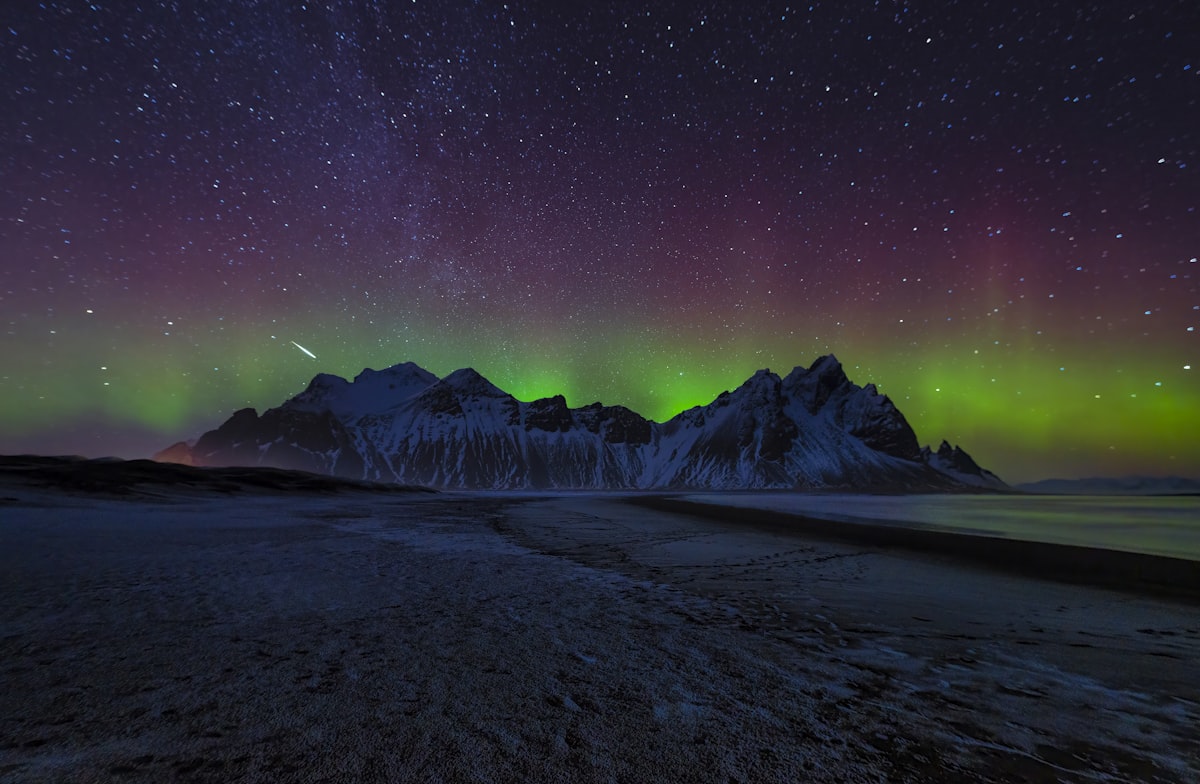
- Vestrahorn — Southeast Iceland near Höfn, dramatic peaks, almost no light pollution; the photo at the top of this guide was taken here, in winter. Stokksnes is private land with an entrance fee paid at the Viking Café, and it is about six hours’ drive from Reykjavík, so treat it as a base rather than an evening trip. Our Vestrahorn guide covers access and the tides.
- Jökulsárlón glacier lagoon — Floating icebergs make for unique foregrounds, and the lagoon’s boat tours are still running in September, so one stop can cover a boat trip by day and the aurora at night.
If you’re chasing weather rather than scenery, our live aurora forecast shows real-time spot-level cloud cover and aurora scoring for all 137 monitored locations across 14 regions, updated every 5 minutes.
How to Plan the Rest of September 2026
Four concrete things to do:
- Make the most of 15-20 September. Every dark hour of those six nights is moon-free, the dark window grows from 4.8 to 5.7 hours, and NOAA’s G1 watch covers the first two. If you only give up sleep once, give it up on one of these.
- Change tactics from the 24th. With the moon up for the whole dark window until the end of the month, faint arcs are out, but a strong display still shows. Keep the alerts on and go out when activity is genuinely high, rather than every night.
- Plan to move. The single biggest determinant of whether you see the lights is whether you can drive 30-60 minutes to find clear sky. Coastal Iceland’s weather varies dramatically over short distances; a single fixed hotel will lose you nights you could have saved. If you are still deciding how long to stay, how many nights you need covers how trip length changes your odds.
- Install the Aurora Iceland app and turn on notifications. We score 137 individual locations every 5 minutes based on real-time solar wind, OVATION model output, and live vedur.is cloud observations. The app alerts you when the solar wind turns favourable while the sky where you are is dark and mostly clear, or when aurora sightings are reported near you.
For the underlying mechanics of how aurora forecasts work — Kp, Bz, OVATION, and what to actually trust — see how to read an aurora forecast. And if your dates run into October, the dark window keeps growing — see our companion guide to the northern lights in Iceland in October 2026.