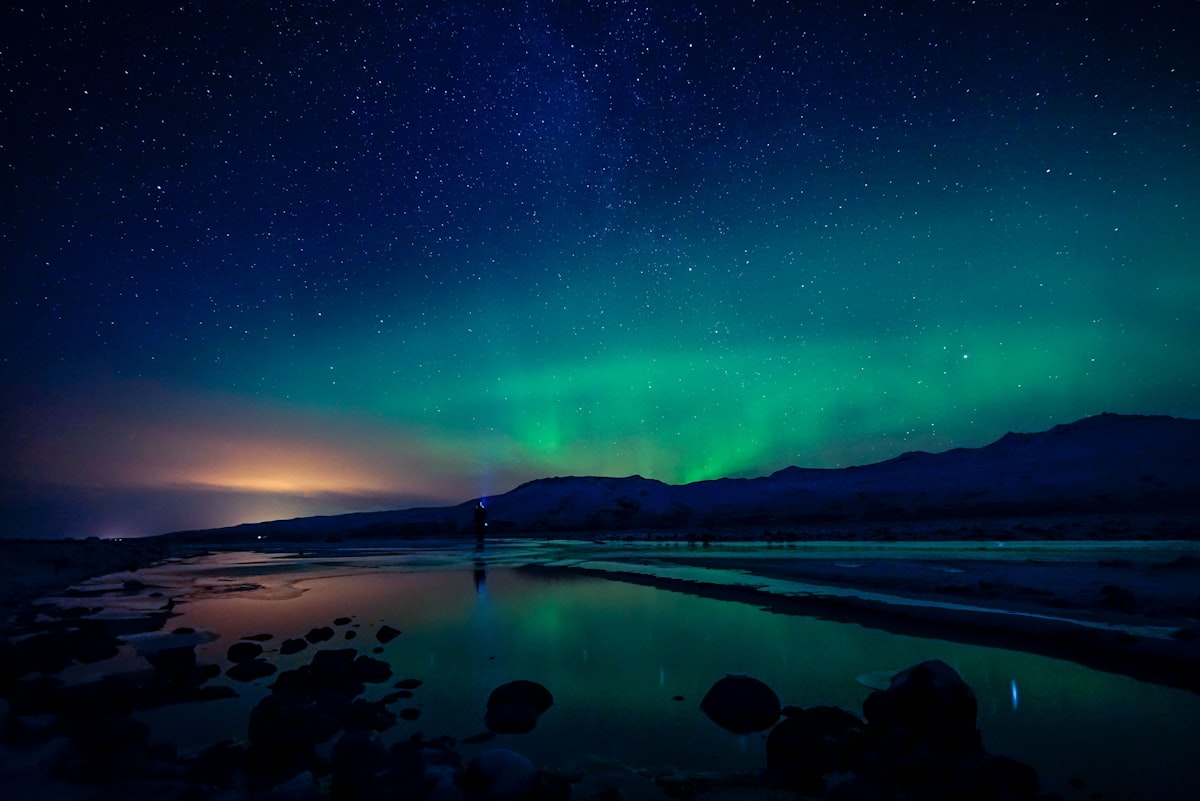
The Short Answer: Yes, But Manage Your Expectations
You can absolutely see the northern lights from within Reykjavik. We see them from the city most active winters, sometimes right from a downtown street if the display is strong enough. But there is an honest caveat that most travel pages skip over: Reykjavik is a city, and city light competes with the aurora. On a quiet night with a faint display, the glow from streetlights and buildings will wash out everything except the very brightest curtains.
So the real answer is: yes on strong nights, and yes from the right spot, but you will see far more by walking ten minutes to a darker corner of the city than by standing under a streetlamp on Laugavegur. This guide explains what to realistically expect, when to look, and how to improve your odds without leaving town.
What City Light Pollution Actually Does
The aurora happens 100 to 300 km overhead and does not care whether you are in a city or a remote fjord. What changes is the contrast between the lights and the background sky. In central Reykjavik, the sky above you is never truly black — it carries an orange-grey glow from thousands of lights below. A faint aurora simply blends into that glow.
Here is the practical rule of thumb we use:
- Kp 1 to 2 (low activity): Usually invisible from central Reykjavik. You need a dark spot to have any chance.
- Kp 3 to 4 (moderate): Visible from darker pockets of the city, harder to spot downtown, easy from the edges.
- Kp 5 and above (strong): Often visible from anywhere in Reykjavik, including busy streets. These are the nights people photograph the aurora over Hallgrímskirkja.
Note that Kp is not the whole story. A southward-tilted interplanetary magnetic field (the Bz component) can produce a vivid display at a modest Kp, while a high Kp with the wrong orientation underwhelms. If you want to understand what the numbers mean before you head out, our guide on how to read an aurora forecast breaks it down.
When You Can See Them From Reykjavik
Two things have to line up: darkness and activity.
Reykjavik’s aurora season runs from late August through mid-April. From May through July the midnight sun keeps the sky too bright at all hours, so there is no viewing regardless of solar activity. September, October, February, and March are the sweet spots, combining long dark nights with milder weather and frequent clear spells. For the full month-by-month picture, see our guide to the best time to see the northern lights in Iceland.
Within a single night, the best window is roughly 10 PM to 1 AM local time, around magnetic midnight, though substorms can fire at any dark hour. Activity comes in waves: a flat, empty sky at 10 PM can erupt into moving green curtains by 11. Patience matters more in the city than anywhere else, because the faint early glow that a dark-sky viewer would catch is exactly the part the city erases.
The third factor, and the one that ruins the most nights, is cloud cover. Any cloud layer blocks the aurora completely. This is also the one problem you cannot solve from a fixed spot in the city center.
How to See More: Get to the Edge of the City
You do not need a car or a tour to dramatically improve your view. Reykjavik has several genuinely dark spots within walking, bus, or short-taxi distance. The standout is Grótta Lighthouse on the western tip of Seltjarnarnes, which has a wide northern horizon and noticeably less light pollution than downtown. On clear nights with Kp 3 or above, Grótta regularly delivers a real display when the city center shows nothing.
Other walkable options, plus bus routes and taxi costs, are covered in our dedicated guide to seeing the northern lights in Reykjavik without a car. The single best move, though, is to face away from the brightest part of the city and let your eyes adjust for fifteen minutes before deciding nothing is happening.
If you do have a car, the leap in quality is significant. A 45-minute drive to Þingvellir National Park puts you under a properly dark sky where even a Kp 2 display becomes obvious, and it lets you drive away from any cloud band that rolls in. Cloud-chasing is the one capability that turns a 50/50 night into a sure thing.
Make the Call With Live Data
The mistake we see most often is people deciding in advance that “the city is too bright” or “tonight looks dead” and staying in. Both are guesses. Conditions in Iceland change by the hour.
Before heading out, check the live score for your chosen spot and the current cloud percentage on our Tonight page, or in the Aurora Iceland app, which scores Grótta, Þingvellir, and over 100 other locations in real time using solar wind data, OVATION aurora probability, and cloud observations from Icelandic weather stations. A score of Possible or better combined with less than 50 percent cloud cover is a reasonable go signal.
Set a decision time of around 10 PM, check once, and commit. The northern lights are visible from Reykjavik more often than most visitors realize. You just have to actually step outside and look.