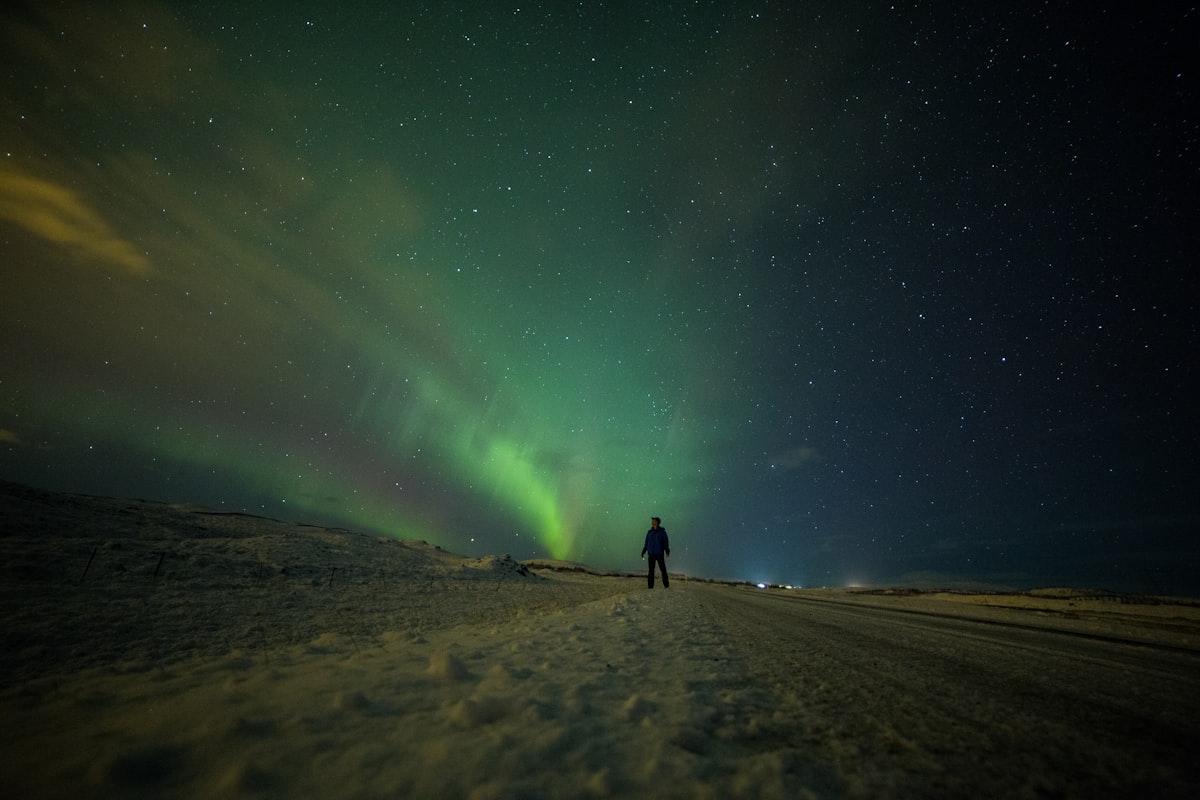
Most Iceland winter packing lists are written for hiking. Aurora hunting is the opposite activity. You drive to a coastal pull-off, park, and then stand still — sometimes for ninety minutes — in a wind that doesn’t stop. The gear that keeps a hiker warm at -5°C while moving will leave you shivering at the same temperature when you’ve stopped moving for an hour.
This is the packing list we actually use. The “we” here is people who chase the lights from late August through April, often at exposed spots like Garðskagi, Reynisfjara, and Þingvellir, where the wind comes off the Atlantic with nothing in the way.
The Core Principle: You Stand Still
Hiking generates body heat. Aurora hunting doesn’t. Your metabolic output is somewhere between sitting on a sofa and waiting for a bus, and you’re doing it in 10–30 km/h wind at temperatures that often sit between -2°C and -12°C from October through March.
That single fact changes every layering decision:
- Down compresses when you sit on it. A great down jacket loses half its insulation value the moment you lean against your car. Synthetic insulation (PrimaLoft, Coreloft) keeps loft under compression. Down is fine for the drive; synthetic is what you want once you’re parked.
- Sweat is the enemy. If you walked to the spot or hauled gear up a slope, you’re already damp under your shell. The wind will pull that heat out fast once you stop. A merino base layer is worth four times its weight in cotton or synthetic — it keeps insulating when wet.
- The wind beats the cold. A windproof outer shell over moderate insulation will out-perform a thicker, less wind-resistant jacket every time. Iceland’s coastal wind chill is the killer, not the air temperature on the thermometer.
The Layers, From Skin Out
A working aurora-hunt layering system for a typical -5°C night with 15 km/h wind:
- Merino base layer top and bottoms. 200 g/m² weight is the sweet spot — heavier traps too much heat on the drive over. Avoid cotton entirely.
- Mid layer fleece or wool sweater. Grid fleece (Polartec Power Grid) is the best ratio of warmth to weight and dries fast if you do work up a sweat.
- Synthetic insulation jacket. A PrimaLoft puffy or similar. This is the layer that keeps loft when you lean against the car or sit on a rock.
- Hardshell windproof outer. Doesn’t need to be heavily insulated — its job is to stop wind and rain. Pit zips help if you walked to the spot warm.
- Insulated trousers or hardshell over thermal leggings. Standing legs lose heat fast. Cheap snow pants over a merino base are better than expensive softshells alone.
For deep cold (sub -10°C with wind), add a second mid layer or swap the puffy for a heavier expedition-weight synthetic.
The Small Items That Decide the Night
These are the items most packing lists skip. They’re the ones that decide whether you stay out for the storm or give up after twenty minutes:
- Chemical hand warmers — in the camera-battery pocket, not your gloves. Cold drains lithium camera and phone batteries fast. A Hothands pack against your spare battery in an inside chest pocket can triple its life. You’ll still want a second set in your gloves for hour two.
- Red-filter headlamp. Your eyes take 15–25 minutes to dark-adapt. One glance at a phone screen or a white headlamp resets that. A headlamp with a red mode (most Petzls have one) lets you see the trail, your camera dials, and your hot drink without burning your night vision.
- Traction spikes (Yaktrax or Kahtoola Microspikes). Iceland parking pull-offs glaze with ice in October and stay that way until April. A fall in the dark on a sloped shoulder of a country road is not the start to the trip you wanted. Spikes weigh nothing and live in the glove box.
- Two pairs of gloves. A thick insulated outer pair for standing, a thin liner pair for camera dials and phone screens. Swap as needed. Single-pair-only is the most common gear mistake — you end up with bare hands at -8°C every time you adjust a setting.
- Insulated flask with something hot. Thirty minutes in, this becomes the single highest-impact item in the bag. Tea, coffee, hot Ribena — anything. Heat from inside lasts longer than another mid layer.
- Buff or neck gaiter. Pulled up over the nose, it keeps the wind off the part of your face that goes numb first and turns into a near-balaclava when you tuck it under a beanie.
For Photographers Specifically
The packing math changes a little if you’re shooting:
- Bring twice as many camera batteries as you think. Cold cuts mirrorless battery life roughly in half, sometimes more on a windy night. Keep the spares warm against your body.
- Lens cloth that won’t freeze stiff. Microfibre stuffed in an inside pocket. Sea spray and breath fog will glaze the front element repeatedly at coastal spots.
- Tripod with leg locks you can operate with gloves. Tiny twist locks that need bare fingers will end your night. Flip-lock tripods are the unsung Iceland gear.
A separate full walkthrough of camera settings lives in the aurora photography settings guide, and the iPhone-specific guide covers the phone path if you’re not bringing a dedicated camera.
What Not to Bring
- Cotton anything. Jeans, hoodies, t-shirts. Cotton in Iceland’s damp cold is hypothermia bait — it absorbs moisture and stops insulating immediately.
- Fashion-only down coats. The thin urban puffer is fine for Reykjavík cafés. It is not fine standing at Garðskagi Lighthouse at 23:30 in a 20 km/h wind.
- Hand-warmer gloves with no insulation. Touchscreen gloves alone are not warm enough for an hour at -5°C. They are a liner layer, not a primary one.
Put It Together With the Forecast
The right gear lets you stay out long enough for the show to actually develop. Auroras rarely peak at the moment you arrive — many of the best displays we’ve seen in Iceland came after sixty or ninety minutes of patient cold. Pack so that the weather can’t be the reason you went home early.
When you’re ready to head out, the Tonight page shows live scores for every viewing spot in Iceland, and the Aurora Iceland app tracks 100+ individually scored locations in real time so you can move toward the clearest sky instead of staying put in the cloud.
Dress for standing still. The lights are worth it.