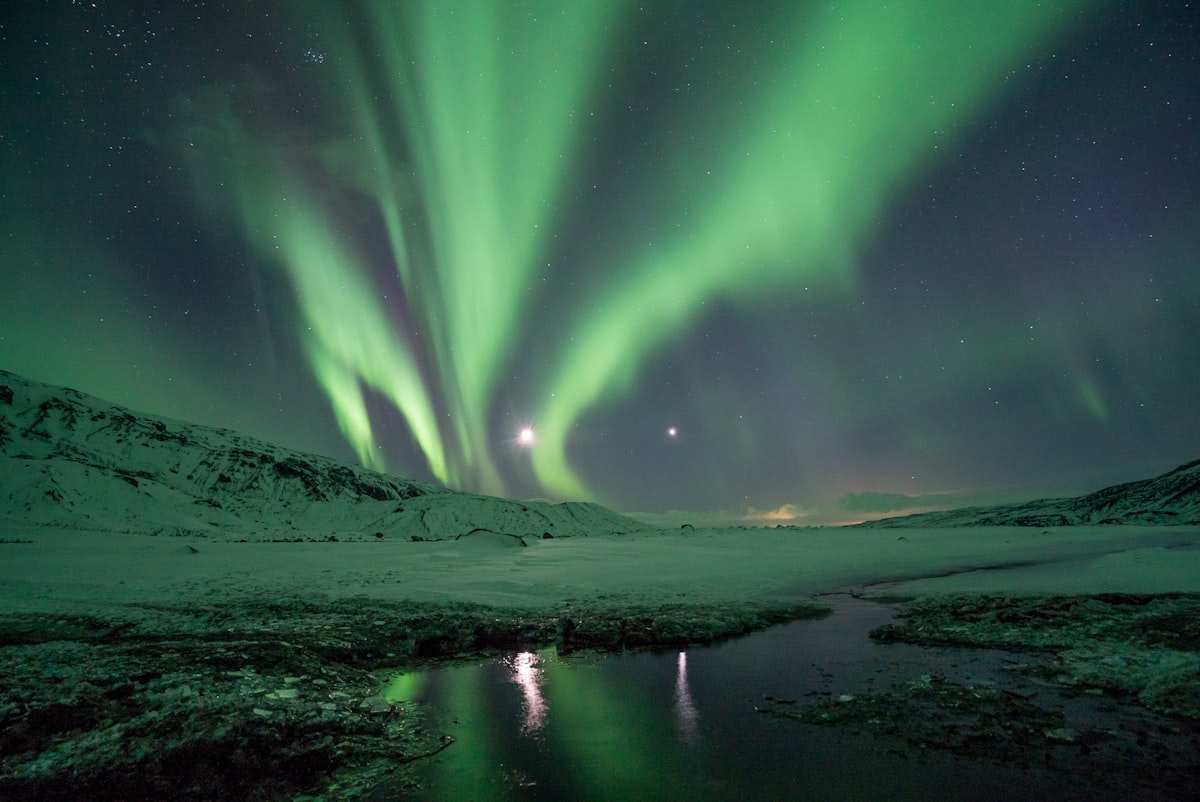
“Should I go north for the northern lights?” is one of the most common questions we get from travellers planning an Iceland trip, and the usual answer online — north is closer to the pole, so north is better — is close to meaningless. Iceland is small enough that the latitude argument barely applies. The real difference between north and south is weather, and that changes the answer completely.
Here is the honest version, based on how the two regions actually behave across a season of scoring 100+ viewing spots every night.
The Latitude Argument Is Weaker Than You Think
Iceland spans roughly 63.4°N at Vík to 66.5°N at the northern coast — about three degrees, or 350 km end to end. On a night with any real geomagnetic activity, the auroral oval sits far north of the entire island and pushes south over all of it at once. There is no line across Iceland where the aurora starts.
In practice, if the aurora is visible at Lake Mývatn, it is almost always visible at Vík too — assuming both have clear sky. At the very bottom of the activity range, a faint arc might hug the northern horizon and read slightly higher from the north coast. That is a marginal edge, not a reason to restructure a trip. Kp is not the variable that decides your night; we explain why in how to read an aurora forecast.
Verdict: latitude is worth a small nudge north, nothing more.
The Real Difference: Cloud and Precipitation
This is where the two regions genuinely diverge, and it is not close.
South Iceland faces the open North Atlantic. Weather systems arrive off the ocean, hit the coast and the glaciers behind it, and dump their moisture there. Vík is one of the wettest inhabited places in the country, with annual precipitation in the region of 2,000–3,000 mm. North Iceland sits in the rain shadow of the highlands and the interior ice caps — Akureyri records roughly 500 mm a year, a fraction of the south coast.
More rain means more cloud, and cloud is the single biggest reason people miss the aurora in Iceland. Around Mývatn and the inland north you get a meaningfully higher share of clear nights over a week-long trip, plus more of the calm, settled, cold-and-dry conditions that make for the best viewing.
Two caveats keep this honest:
- North Iceland is cloudier in a northerly airflow. When the wind swings round to the north, the pattern inverts and the south coast is the clear one. Neither region is reliably clear; they are just clear on different nights.
- Winter roads matter more up north. Mountain passes on the way in and out of the north close more often, so a car-based plan needs more slack.
If you only take one thing from this article: pick your region for the trip, then pick your spot for the night based on where the cloud actually is. Our guide to what to do when the forecast says cloudy covers the routing side of that.
Access, Cost and Time Budget
The south wins on logistics, and for short trips that usually decides it.
- South: you land at Keflavík. Dark, genuinely good aurora sites are 40–60 minutes from Reykjavík, and the Ring Road east opens up Vík, Dyrhólaey and Jökulsárlón. The greatest density of tours, rental cars and accommodation is here. If you have three nights, this is almost certainly your answer.
- North: Akureyri is a 45-minute domestic flight or a 5-hour drive from Reykjavík. That is a real chunk of a short itinerary. What you buy with it is darker surroundings, shorter drives between good spots once you are there, and fewer people. From an Akureyri or Mývatn base, several strong sites are within 30 minutes.
Note that Akureyri town itself has a light dome like any town of 20,000 people. “North Iceland is darker” is true of the region, not of standing in the middle of its largest settlement. We cover the workable local sites in our Akureyri guide and the Mývatn and Húsavík guide.
Foregrounds: A Genuine Tie
If you are photographing, the two regions offer different but equally strong compositions.
South: the glacier lagoon at Jökulsárlón with icebergs catching the green, the sea stacks at Reynisfjara, and Vestrahorn’s ridge over the black sand at Stokksnes. Dramatic, famous, and busy even at midnight in peak season.
North: Goðafoss with the aurora over the falls, the pseudocraters and open water around Mývatn, and the wide harbour views from Húsavík. Quieter, more space, and steam from the geothermal areas can add atmosphere — though it can also fog a lens.
Neither region is short of foreground. Choose on weather and travel time, not scenery.
How to Actually Decide
A practical framework:
- Trip of 2–4 nights? Stay south. The travel time north eats too much of your aurora budget, and the Reykjavík area has enough dark spots within an hour to work with. See how many nights you need.
- Trip of 5+ nights? Do both. Split the trip and treat the two regions as two independent weather rolls — that is the single best way to raise your odds across a week.
- Going specifically to hunt aurora, weather-optimising above all? Base in the north, near Mývatn, and accept the extra travel.
- Whichever you choose, decide the night itself on live data, not on the region you booked. That is what our per-spot scoring is for: it combines cloud cover, darkness and geomagnetic activity for each of 100+ named locations, so you can see at 20:00 whether tonight belongs to the coast, the inland valleys, or nowhere at all.
If you are driving between regions, our self-drive planning guide covers how to structure the night around darkness and cloud rather than distance.
The short answer to north vs south: the sky is the same, the weather is not, and the clouds decide. Check tonight’s scores for both regions on the live aurora forecast, or get them per spot with the Aurora Iceland app and let the data pick your side of the country for you.