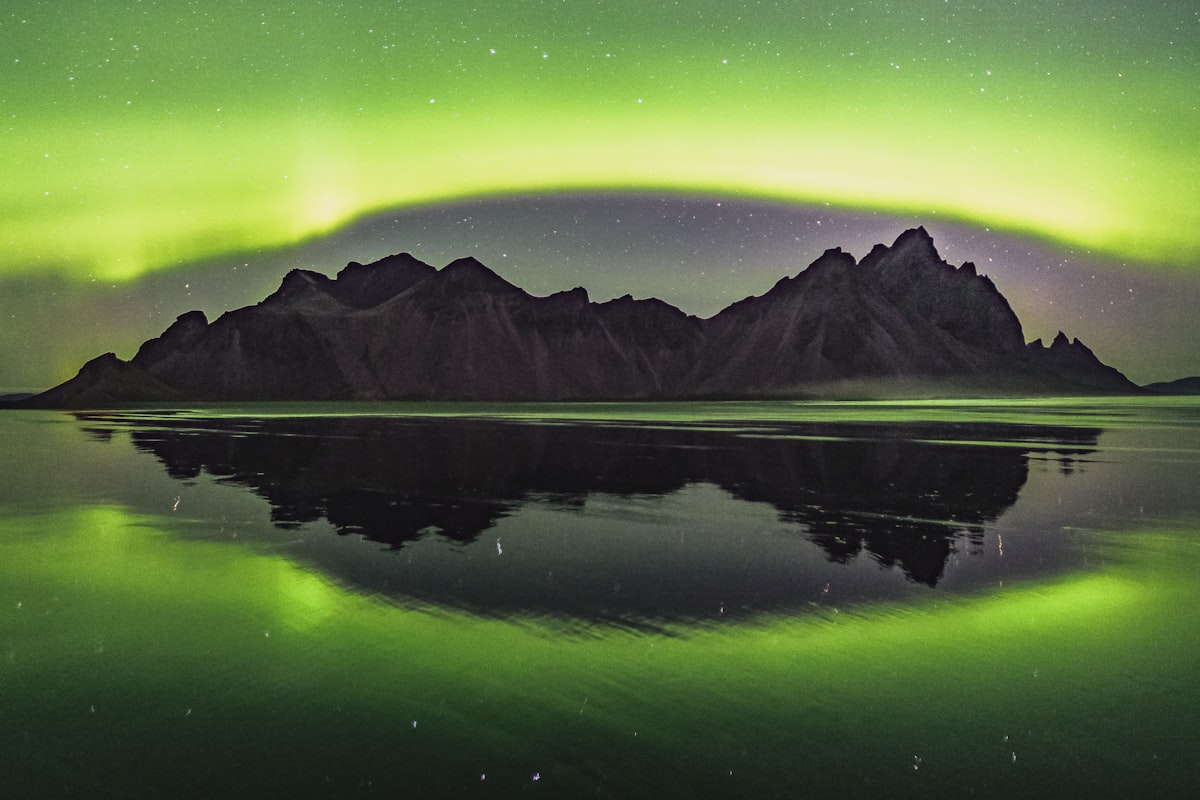
The question every aurora trip planner asks before booking flights: how many nights in Iceland do I need to actually see the northern lights?
The unhelpful but honest first answer is “it depends.” The useful answer requires breaking the question into the three independent things that have to line up on any given night: the sun has to be active, the sky has to be clear somewhere reachable, and you have to be outside and looking when both happen. None of these is guaranteed, and they aren’t perfectly correlated. So trip length is really a question of how many independent chances you give yourself to roll three dice at once.
Here is the honest math, the realistic odds by trip length, and what changes those odds more than adding another night.
The Three Dice You Have to Roll Every Night
A successful aurora viewing depends on three independent things being true at once, between roughly 21:00 and 02:00 in Iceland:
- Geomagnetic activity high enough to produce a visible display. During solar maximum — which we are in right now through 2026 — most nights have at least the baseline activity needed for a faint to moderate display visible from a dark spot. During solar minimum, this drops dramatically. We’re tracking solar cycle 25’s effect on Iceland aurora here.
- Clear sky over somewhere reachable. This is the single biggest spoiler. Iceland’s mid-Atlantic position puts low-pressure systems over the country constantly from autumn through spring. Total cloud cover over the entire country at the same time is rare — but you have to be willing to move to find the gap. If your night is “we’ll watch from outside our hotel,” you’ve cut your effective coverage to whatever the sky happens to do above one specific roof.
- Real darkness. From late August through mid-April you have at least some astronomical darkness. From mid-April through late August you don’t, and aurora is invisible regardless of solar activity. We cover the seasonal window in more detail here.
The trip-length question is really about how many chances you give yourself for all three to align in the same five-hour window. Adding nights doesn’t change any single night’s odds. It just multiplies your chances.
Realistic Success Rates by Trip Length
These rough probabilities assume late September through early April (full darkness), a moderately active sun (we have one through 2026), and a guest who is willing to drive at least 30 minutes from their hotel to escape cloud. Numbers come from working backwards from our own per-night scoring data across the 2024-25 and 2025-26 seasons.
| Nights in Iceland | Realistic chance of at least one aurora sighting |
|---|---|
| 1 | ~30% |
| 2 | ~50% |
| 3 | ~65-70% |
| 4 | ~80% |
| 5 | ~85-90% |
| 7+ | ~93-97% |
A few honest caveats about that table:
- The shape of the curve matters more than the numbers. Each additional night adds less marginal benefit than the last. The jump from 1 to 3 nights almost doubles your odds. The jump from 5 to 7 nights barely moves the needle.
- These are sighting odds, not photography odds. “Saw the aurora” can mean a faint green glow low on the horizon. A vivid, dancing, fill-the-sky display is rarer — closer to 40-50% over a 5-night trip even at solar max.
- Stationary viewers should subtract roughly 20 points across the board. If you cannot move when the closest clear sky is two hours away, you forfeit the nights where clouds win.
What Changes Your Odds More Than Adding Nights
If you’re trying to decide between four nights and five, or between five and seven, the marginal night is doing less work than these three other variables.
When you go. September and March are statistically the most productive months in Iceland — the combination of full darkness, equinox-boosted geomagnetic activity, and slightly less cloud cover than midwinter all helps. December and January have more darkness hours per night but also the worst cloud cover. A three-night trip in early March will, on average, beat a five-night trip in late December. We’ve written about this trade-off in Best Time to See the Northern Lights in Iceland.
Whether you’re willing to drive. This is the variable most under your control and the one most trip planners underweight. On any given night in Iceland, the country is rarely 100% cloudy. There is usually a clear pocket somewhere — north, east, south, or interior. A guest with a rental car who is willing to move 60-90 minutes will catch displays that a guest fixed to a Reykjavík hotel will miss entirely. We dig into the chase logic in How to Chase a Clear Sky in Real Time and the tour-vs-self-drive trade-off in Tour or Self-Drive?.
Whether you’re awake for the window. The aurora doesn’t care about your jet lag. Most displays in Iceland peak between 22:00 and 01:00, and many of the best of the 2025-26 season actually started after midnight. A guest who fades by 22:30 because of a 16-hour travel day forfeits half the prime window. Day-one nights are nearly always a write-off for this reason — plan accordingly.
The Realistic Sweet Spot: Four to Five Nights
For most trip planners, four to five nights is the practical sweet spot. Four nights gets you above 80% odds without bloating the trip budget. Five nights buys you a meaningful buffer against a single weather-trapped stretch and pushes you into the high 80s. Anything past five gives diminishing returns unless your trip has other reasons to be longer (Ring Road, glacier tours, the August eclipse).
Shorter trips can work but require accepting more lottery risk:
- Two-night trips are realistic if Iceland is a stopover on a longer European itinerary. Pick a spot with mobility (a rental car beats a Reykjavík-only base), watch the forecast closely, and accept that one bad cloud night writes off half your chances.
- One-night trips — usually Keflavík airport layovers — are pure lottery. They can work, and we have a dedicated layover guide for making the most of them, but you shouldn’t book the trip for that purpose alone.
Trips longer than seven nights stop being aurora-driven decisions and start being broader Iceland trips that happen to include aurora chances. That’s a great way to travel — just be honest with yourself that night eight isn’t really about the lights.
The August 2026 Eclipse Wrinkle
If you’re booking around the August 12 solar eclipse, the aurora math shifts. Mid-August in Iceland is still firmly in the no-darkness window — the sky never fully darkens enough to see the aurora, even when the sun is active. The aurora season effectively begins in late August, and most operators consider the first reliable viewing nights to start around August 20-22.
A trip that arrives for the August 12 eclipse and leaves before August 20 will get zero aurora chances regardless of length. A trip that extends through late August picks up the very first nights of the new season — usually a handful of marginal but real opportunities. We’ve written about whether the extension is worth it here. The short answer: yes for keen aurora hunters, no for casual viewers.
Make the Nights Count
Whatever number of nights you book, the goal is to extract maximum value from each one. That means:
- Check live conditions, not five-day forecasts. Cloud and aurora forecasts beyond 48 hours are unreliable in Iceland. Use a service that updates frequently and surfaces the actually-clear spots in real time.
- Be ready to drive. A rental car you don’t use is far better than no rental car when a cloud break opens 40 minutes away at 23:00.
- Pack for standing still. Most trip-planning effort goes into chasing logistics and zero into the gear that actually keeps you outside long enough for the display to develop. Our winter packing list is the field-tested version.
The Tonight page on Aurora Iceland shows live scores for every viewing spot in the country, updated every five minutes, and the Aurora Iceland app tracks all of them so you can move toward the clearest sky in real time instead of guessing from the hotel window.
Four to five nights, willingness to drive, and good gear will get most visitors a sighting. Anything less is possible. Anything more is a longer Iceland trip — which is its own good idea, but not really an aurora question.