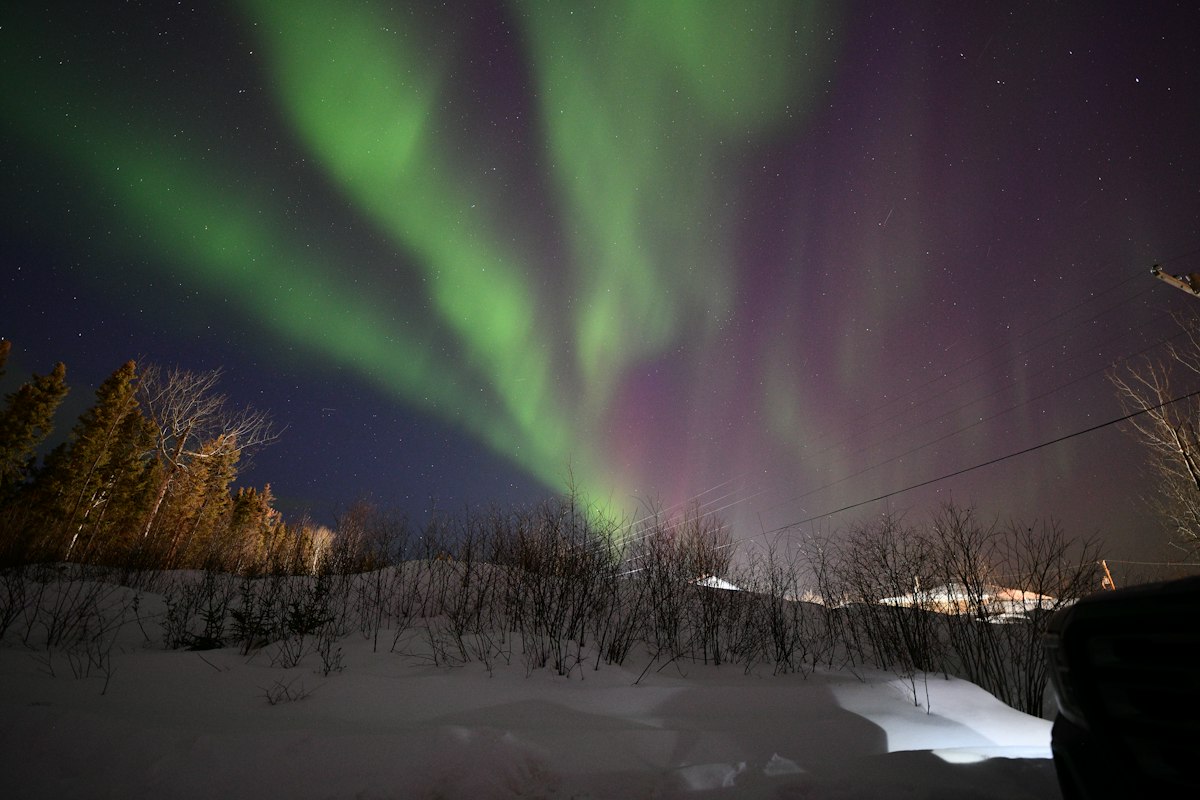
The Short Answer: Each Colour Is a Different Gas at a Different Height
The northern lights are made by electrons from the solar wind crashing into the upper atmosphere. Each collision gives an atom or molecule a little extra energy, and when it lets that energy go it gives off light of one exact colour. Which gas is hit, and how high up it is, decides the colour. That is the whole story, and it explains why almost every aurora you see in Iceland is green, why purple shows up at the edges, and why red is rare.
There are only two gases that matter here: oxygen and nitrogen, the same two that make up the air you breathe. Higher up, the air is thin and dominated by single oxygen atoms. Lower down, it is denser and molecular nitrogen becomes important.
Green: Oxygen at 100 to 200 km
The green you see in nearly every aurora photo comes from atomic oxygen glowing at a wavelength of 557.7 nanometres. It is brightest roughly 100 to 200 km above the ground, which is where most incoming electrons deposit their energy.
Green dominates for two reasons. First, that height band is where the action is, so most of the light is produced there. Second, 557.7 nm sits almost exactly at the peak sensitivity of the human eye’s colour receptors. Of everything the aurora emits, green is the colour your eye is best at seeing, which is why it is the first colour to appear as a display brightens.
Even so, a faint aurora often looks grey rather than green, because in the dark your eye runs on colour-blind receptors. We explain that in detail in what the northern lights look like to the naked eye. The short version: green is the colour that arrives first, but it still needs a reasonably bright display.
Red: Oxygen Again, but Much Higher
Red aurora is also made by oxygen, at 630.0 nm, but it comes from above about 200 km. The reason it only appears that high is timing. An oxygen atom in the state that produces red light holds its energy for close to two minutes before releasing it. Lower down, the air is dense enough that the atom bumps into a neighbour long before then and loses the energy without glowing. Only in the very thin air at the top of the atmosphere does it get left alone long enough to shine.
Because there is far less gas up there, red is faint. Your eye is also poor at seeing deep red in the dark. Put those together and red is usually invisible except during strong geomagnetic storms, when the energy pouring in is large enough to light up the high atmosphere brightly. In Iceland, a sky with obvious red in it is a sign you are watching an unusually powerful night, not a typical one. A camera picks up faint red tops on curtains much more often than your eyes do.
Purple, Blue and Pink: Nitrogen
The other colours come from nitrogen, and there are two versions worth knowing:
- Blue and violet come from nitrogen molecules that have been ionised, glowing at around 391 and 428 nm. You will most often notice it as a bluish or purple tint at the top of tall curtains early in the night, when the highest part of the aurora is still in sunlight even though the ground is dark. This “sunlit aurora” is most common around the equinox months, when the darkness window is shorter.
- Pink and magenta come from neutral nitrogen molecules glowing red at the lower edge of a curtain, around 90 to 100 km, blended with the green above it. It only appears when very energetic electrons push deep into the atmosphere, which happens during the bright, fast-moving phase of an active display. If you see the bottom of a curtain ripple with a pink hem, the aurora is having a strong moment.
So the purple you see in many photos is a real colour from real nitrogen. Cameras exaggerate it, because a sensor is far more sensitive to blue and red than your eye is at night, but they do not invent it.
Which Colours Will You Actually See in Iceland?
Iceland sits close to the band where the aurora is most frequent, so the light is usually overhead or high in the northern sky rather than glimpsed over the horizon. That shapes what you can expect:
- Most nights: grey to pale green. A modest display reads as a silvery arc that turns green as it brightens.
- Good nights: clear green, with motion. When the forecast reaches the Good or Excellent range, the green becomes obvious to the eye and curtains start to move.
- Strong moments: a pink lower hem. During the bright bursts of an active night, the bottom edge can flash pink. These moments often last only a few minutes.
- Storm nights: red and purple. Visible red needs a strong storm. Purple tops are easier for a camera than for the eye.
The colours you get depend most on how energetic the display is, which you cannot control, and on how dark and clear your sky is, which you can. Light pollution and cloud wash out the faint red and violet first. A dark site such as Þingvellir gives your eyes the best chance, and our camera settings guide shows how to record the colours your eyes miss without over-saturating them.
Find the Night Worth Watching
Colour follows intensity, and intensity follows the solar wind. Our guide on how to read an aurora forecast explains which numbers point to a strong night. Or let us do the work: the Aurora Iceland app scores 137 viewing spots every five minutes from solar wind, cloud and darkness, so you know whether tonight is a pale-green night or one worth staying up for. Check the live aurora forecast before you head out.